
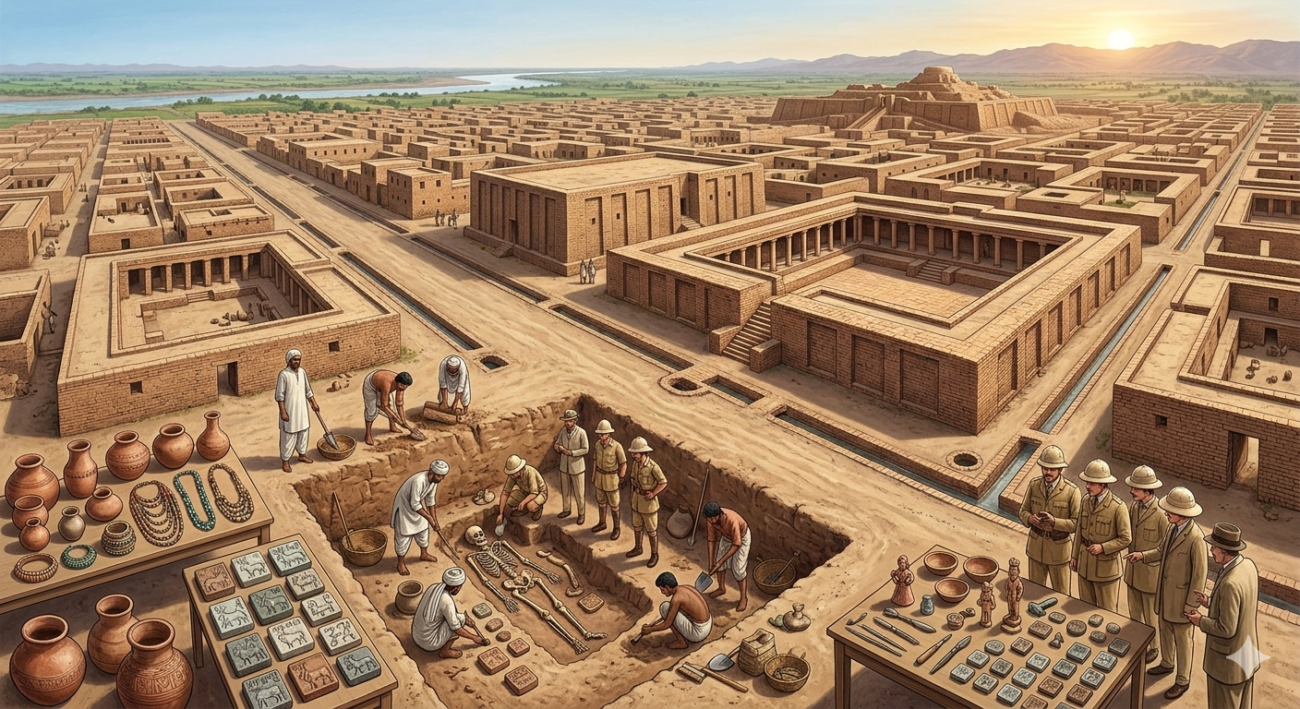
Until the beginning of the 20th century, the British had been justifying their 200-year rule in India by calling it “tolerant imperialism.” Their claim was that they had done India a favor by making it “cultured.” However, they were unaware that this land had already lived through a Golden Era thousands of years prior.
Their arrogance was shattered in 1921, when one of the world’s earliest civilizations was discovered in India, known as the Indus Valley Civilization. Approximately 100 years ago, the discovery of two major cities—Harappa and Mohenjo-daro—proved that a well-cultured and civilized society existed in India nearly 5,000 years ago.
These cities were not ordinary settlements; they featured:
- Organized roads
- Massive buildings
- An amazing and sophisticated drainage system
Over time, excavations revealed terracotta pots, precious jewelry, skeletons, and various statues that tell stories of the culture and lifestyle of that era. As the excavation of the civilization progressed, an entire world came to light. While the agriculture, trade, technology, and architecture of this civilization left the world in awe, its water management and drainage systems were so magnificent that even today, many cities across the world lack such facilities.
Decades of excavation also uncovered the script of that time. Surprisingly, while the languages of other ancient civilizations like the Mesopotamian and Egyptian have been deciphered, the script of the Indus Valley Civilization remains unsolved even after 100 years of effort.
So, let us explore the story of this ancient and great Indus Valley Civilization…
What is so special about this civilization that it left the entire world in awe? How were these cities, buried under mounds of debris, finally discovered? Why has the language of this civilization remained undeciphered even after a century of research? And what exactly happened that led to the end of such a grand civilization, leaving its existence to be told only through ruins today?
To understand the discovery of the Indus Valley Civilization, we must travel back nearly two centuries. In 1829, Charles Masson, who had left his job with the East India Company, was traveling to Lahore to meet Maharaja Ranjit Singh, the ruler of the Sikh Empire.
Upon reaching the Punjab province, he came across a site filled with numerous ruins and various remains that bore witness to their extreme antiquity. He was unaware that he had accidentally stumbled upon an ancient city of one of the world’s oldest civilizations. However, his passion for history was so strong that he began documenting everything he saw. Later, he published this information in his book under the title “Arrival at Harappa.”
Following this, in 1831, British traveler Sir Alexander Burnes, and in 1853, Sir Alexander Cunningham—a British military officer with a keen interest in archaeology—visited Harappa.
Alexander Cunningham was so fascinated by this site that he visited it again in 1856. During this visit, he discovered several coins in the ruins, which served as evidence of a civilization thousands of years old. To Cunningham, everything about this place seemed like a mystery that he was determined to solve.
Consequently, after retiring from the rank of Major General in 1861, he focused on establishing a dedicated organization for archaeological study and conservation. It was through his initiative that the Archaeological Survey of India (ASI) was founded in 1861, and he was appointed as its first Director-General. Alexander Cunningham was the primary individual responsible for bringing this site under the protection of the ASI.
Around 1872 and 1873, he conducted some small trial excavations at the site. Based on the objects and information gathered, he published the first ASI report, which mentioned the discovery of a specific seal. This black-colored seal featured a humpless bull carved into it, with two stars positioned below its neck and an inscription of six characters written above the bull.
The most significant turning point in the discovery of Harappa occurred after Sir John Marshall became the Director-General of the ASI in 1902. John Marshall decided to initiate large-scale excavation work at Harappa and entrusted the responsibility to Indian archaeologist Daya Ram Sahni.
In 1920, under the observation of Daya Ram Sahni, the formal excavation of the site began. A year later, Sahni began discovering a vast quantity of ancient remains near the banks of the Ravi River in the Montgomery district of the Punjab province. By that time, carbon dating technology had emerged, and investigations estimated these remains to be several thousand years old. In this way, the discovery of a city was confirmed for the first time, sparking global conversations about this civilization found in India. Since the local people knew the area as Harappa, the city was named accordingly.
Thus, this city was named Harappa. Archaeologists anticipated that this civilization might be spread over a vast distance. To explore the maximum possible area, D.R. Bhandarkar, R.D. Banerji (Rakhal Das Banerji), and M.S. Vats were also assigned to the project.
In 1922, while excavating near the Indus River, approximately 590 km north of Harappa, R.D. Banerji discovered ancient remains similar to those found in Harappa. Upon investigation, these too were found to be thousands of years old. At this site, several human skeletons were found piled on top of one another. Consequently, the place was named Mohenjo-daro, which literally means “Mound of the Dead.”
Following these discoveries, in 1924, Sir John Marshall officially announced the discovery of an ancient civilization in British India through a London-based magazine. Since two major cities—Harappa and Mohenjo-daro—along with several ancient villages were found along the banks of the Indus River, it came to be known as the Indus Valley Civilization. Because Harappa was the first site to be discovered, it is also referred to as the Harappan Civilization.
The existence of this civilization stunned the entire world. Until then, the Mesopotamian, Egyptian, and Chinese civilizations were considered the world’s largest ancient urban civilizations. With the discovery of the Indus Valley Civilization, it joined the ranks of the four oldest civilizations in the world.
While some researchers estimate the Indus Valley Civilization to be 5,000 years old, certain evidence suggests it could be as ancient as 8,000 years. The search for Indus Valley sites has continued for over a century, and to date, more than 1,400 sites have been discovered.
Currently, out of the total discovered sites, 925 sites are in India and 475 are in Pakistan. Among these, nearly 100 sites were found near the Indus River, while approximately 500 sites were discovered around the Ghaggar-Hakra River. This search continues to this day. Based on research conducted on the discovered cities and sites, historians have learned when and how the Indus Valley Civilization began and how far it extended.
Compared to the civilizations of Mesopotamia, Egypt, and China, the Indus Valley Civilization was spread across the largest area. It covered approximately 1.26 million square kilometers, stretching across modern-day India, Pakistan, and Afghanistan. Prominent sites like Harappa, Mohenjo-daro, and Amri are located in Pakistan, while Kalibangan, Lothal, Surkotada, Banawali, and Dholavira are situated in India. At its peak, nearly 5 million people lived in the Indus Valley Civilization.
The history of this civilization is divided into three phases:
- Early Harappan Phase 2. Mature Harappan Phase 3. Late Harappan Phase
The Early Harappan Phase began in 3300 BCE, when people from hilly regions started gathering on the lands along the banks of the Indus and its tributaries. These areas were highly fertile, making agriculture easy, which led people to settle there permanently. Gradually, the population grew, and by 2600 BCE, tribes evolved into villages, which later transformed into cities.
The period between 2600 BCE and 1900 BCE is known as the Mature Harappan Phase, considered its Golden Era. It was during this time that places like Harappa, Mohenjo-daro, and Lothal transformed into massive urban centers.
The cities of the Indus Valley Civilization were built with an incredibly interesting pattern. Every city was divided into two major segments:
- The Lower Mound (Lower Town): This was the main residential area where the common people lived.
- The Upper Mound (Citadel): Built on higher ground, this area housed all the significant buildings, including marketplaces, workshops, and meeting places. Large granaries were also located here to store surplus grain. According to some experts, the Upper Mound was not for public gatherings but was a fortified area reserved for the elite class.
Both the Upper and Lower Mounds were surrounded by massive boundary walls to protect the city from wild animals and floods. This design highlights the advanced engineering and urban planning skills of the Indus Valley people.
Architectural Brilliance
The structure of the houses was equally fascinating:
- Grid Layout: Houses were built in organized blocks with wide roads between them for easy movement.
- Standardized Bricks: Every brick used in construction had a similar dimension, showing a high level of standardization.
- Private Bathrooms: Every house had a bathroom in the corner. A small drain from the bathroom connected to a main underground drainage network that carried wastewater and sludge out of the city.
The drainage system was so magnificent that even today, many modern cities do not possess such efficient facilities.
Water Management and The Great Bath
The management of water resources was exceptional:
- Public Wells: Clean water wells were available throughout the city for drinking and cooking.
- The Great Bath: During the excavation of Mohenjo-daro, a massive water tank called “The Great Bath” was discovered. Built with exquisite brickwork, it spanned 897 square feet with a depth of about 8 feet.
- Facilities: This bathhouse was likely used for religious and social rituals. It featured a nearby well to fill it with fresh water and included changing rooms for the convenience of the people.
Furthermore, to prevent future water crises, these cities featured various water storage systems, reflecting their forward-thinking approach.
In the city of Dholavira, such solar reservoirs (water storage tanks) and water channels were discovered, which were used to store floodwater and water from rivers. Even in those ancient times, the Indus Valley Civilization was far ahead of its era in terms of civic sense. The people here paid special attention to hygiene; dustbins were placed along the streets at various intervals to throw garbage, and signboards were used to provide important instructions.
A Peaceful and Egalitarian Society
Despite having such an organized way of life, no evidence of a specific ruler or governing system has been found in the Harappan Civilization. Studies suggest that the people lived together in an egalitarian manner. They neither had a standing army nor weapons of war; in fact, no evidence of warfare has been discovered in this entire civilization.
Religious Beliefs and Nature Worship
While archaeologists did not find any evidence of temples during their research, the religious nature of the Indus Valley people can be inferred from certain discovered seals. These include:
- The Pashupati Seal: Depicting a figure sitting in a yogic posture wearing a trident-like headgear, surrounded by animals like an elephant, tiger, buffalo, and rhinoceros. This seal also features several bangles, a headdress, and a seven-letter inscription at the top.
- Symbolism: While some estimate that they worshipped an early form of Lord Shiva, many seals also feature the Pipal tree and the One-horned Unicorn.
- Nature Worship: It is believed that instead of worshipping traditional deities, Harappans gave more importance to nature, including tree, snake, and fire worship.
Art, Craft, and Lifestyle
The people of the Indus Valley were not only masters of architecture and technology but were also highly skilled in art.
- The Dancing Girl: A famous bronze statue found in Mohenjo-daro depicts a dancing girl, proving that singing and dancing were developed art forms and means of entertainment.
- Materials: They used clay, stone, and metals to create jewelry, toys, and utensils. While stone tools were common, they were also well-acquainted with gold, silver, copper, lead, and bronze, using them to craft beautiful ornaments.
Economy: Agriculture and Global Trade
The livelihood of the Indus Valley people depended mainly on agriculture and trade.
- Crops: They cultivated wheat, barley, pulses, mustard, vegetables, and spices.
- Cotton Pioneers: They were the first people in the world to use cotton. Farmers would spin and weave cotton, and there was also a trend of wearing woolen clothes.
Along with agriculture, the people also practiced animal husbandry. Animals such as camels, buffaloes, goats, dogs, and cats were domesticated, and bullock carts were used for transportation. Furthermore, they were exceptionally skilled in business. Their trade was not limited to local exchange; it extended to a global level. During that era, they traded with the cities of the contemporary Mesopotamian Civilization.
In Mesopotamian records, the Indus Valley was known as “Meluhha.” The Mesopotamians imported cotton, timber, and ebony in high volumes from here. Luxury items like sesame oil and Lapis Lazuli (a deep-blue metamorphic rock) were also imported from the Indus Valley. Moreover, the Indus people used seals for trade, which featured unique symbols serving as a “brand” or mark of identification. To ensure accuracy in commerce, they utilized sophisticated weights and measuring equipment.
The Unsolved Mystery: The Indus Script
While archaeologists have learned much from the seals and remains, countless mysteries remain unsolved simply because researchers, despite a century of effort, have failed to decipher the language of this civilization. The Indus Valley had its own distinct language, evidenced by thousands of seals, terracotta tablets, and metal objects bearing inscriptions known as the Indus Script.
Historians have been trying to decode this script for nearly 100 years, but no breakthrough has been made. Unlike the Indus Valley, the languages of other ancient civilizations—such as the Mesopotamian, Egyptian, and Chinese—have already been understood.
For instance, historians were able to decode the Egyptian language because of a discovery made about 200 years ago: the Rosetta Stone. This large stone featured a decree written in Egyptian Hieroglyphs, which no one could understand at the time, but the same text was written below in Ancient Greek. Since scholars understood Greek, the stone acted as a “Google Translate” of its time, allowing the world to finally unlock the history of ancient Egypt.
The problem is that no such bilingual tablet or stone has been found for the Indus Script. Consequently, the language remains a mystery. Nevertheless, there have been more than 100 attempts to decode the script, from which a few things can be said with certainty…
First, it has been observed that the language of the Indus Valley Civilization was written from right to left, rather than left to right. In some found scenes, which mostly consist of signs, it was noticed that whenever the signs were ending on the left side, they were written very closely together and made smaller. This is exactly like how, when we are writing and start running out of space, we write the last words very small and cramped.
Second, it was observed that on the seals where there was text in the Indus script, the symbol of a large animal was engraved below it. Images of animals such as the rhinoceros, elephant, tiger, and bull are found on these seals. The most remarkable thing is that looking at them, it seems as if these pictures and text should belong on a very large stone; however, in reality, these stone seals were very small—ranging from just 2.5 square cm to 5 square cm—yet they managed to fit both the text and the animal pictures.
In the attempt to understand the language of this civilization, historians have collected the signs and symbols of the Indus script, finding that there were 400 distinct signs. Some signs and symbols look like stick figures, while others resemble fish, turtles, crabs, insects, and birds.
Because the number of symbols in the Indus script is so high, historians believe that it is a logo-syllabic script. In a logo-syllabic script, such signs are used to express either a specific word or a sound. To understand this with an example: English is an alphabetic language consisting of 26 letters. A single letter usually has no meaning on its own; it only gains meaning when letters are joined to form a word.
Conversely, if we look at the Chinese language, it has no “letters.” The Chinese language is logo-syllabic, consisting of different signs where each sign can have its own separate meaning. Similarly, the Indus Valley Civilization used a language of signs and symbols. Among the seals found, it was observed that most inscriptions consisted of only five signs, though some inscriptions were found containing as many as 26 symbols.
Since the people of the Harappan culture also engaged in foreign trade, some seals with the Indus script have been found in Persia and Mesopotamia. In the early days, when these seals were first discovered in Mesopotamia, many researchers assumed they were a part of the Mesopotamian script, suggesting that the Indus script might have developed from it. However, all such claims were later dismissed.
The puzzle of the Indus script is so deeply entangled that historians have yet to agree on a single theory. Everyone has their own opinions and assumptions; at times, the Indus script is linked to Sanskrit, and at other times, it is associated with the Dravidian language family. On the other hand, historian Steve Farmer argues that the signs found on the seals are not a language at all. He suggests that if it were a true language, the seals would feature long texts similar to those found in Egypt or Mesopotamia. According to him, the Indus Valley signs might have merely been used to denote specific items or commodities.
But the truth remains unknown. More than a century has passed since the discovery of the Indus Valley Civilization, yet its script remains a riddle—one that continues to thrill and fascinate. The intensity of this mystery can be gauged by the fact that Tamil Nadu Chief Minister M.K. Stalin recently announced a reward of $100,000 from his government for anyone who successfully decodes the script. It remains to be seen when the mystery of the Indus script will finally be solved.
However, the mystery isn’t limited to the language alone. Another profound secret is: how did such an advanced, modern, peaceful, and wealthy civilization come to an end? According to archaeological records, between 1900 BCE and 1300 BCE, this civilization underwent a rapid decline. This period is known as the Late Harappan Phase.
It is believed that although several cities of this civilization had been destroyed by floods and other calamities many times before, they were rebuilt every single time using the same grid patterns. Mohenjo-daro, for instance, was rebuilt at least nine times. However, as time passed, conditions began to deteriorate. City planning ceased, and the maintenance of sewers and drainage systems on the roads was neglected. The Great Bath was filled with waste, and trade links with Mesopotamia were severed.
By 1700 BCE, most of the cities had been vacated. People were no longer using the same writing system, nor were standardized weights or building ratios being maintained. The Late Harappan Phase continued until about 1300 BCE, after which this civilization became a closed chapter of history forever.
Theories of Decline: A Great Debate
Just as there is no consensus on the Indus script, the cause of the civilization’s decline remains highly debatable. Several theories have been proposed:
- Climate Change & Drought: One theory suggests constant environmental changes led to a lack of monsoons in the region. This caused frequent droughts, making agriculture impossible. As the rivers dried up, the very foundation of their farming and trade collapsed, bringing economic activities to a sudden halt. It is believed that after decades of such conditions, many died of starvation while others migrated toward the Ganges plains.
- Natural Disasters: Many researchers propose the theory of large-scale natural disasters, such as massive earthquakes or catastrophic floods, which might have ruined the entire civilization.
- Epidemics: Another theory suggests that an uncontrollable epidemic might have broken out, leading to the end of the population. Over time, these settlements were buried under the earth, and new cities and civilizations began to take birth over them.
- The Aryan Invasion Theory: It is also hypothesized that Aryans from the hills to the west invaded the territory. Since the Indus people were peace-loving and lacked a military, they could not withstand the invasion. This led to large-scale massacres and forced migration.
An Unfinished Story
However, these remain mere theories; the absolute truth is still unknown. It has been over 100 years since the discovery of the Indus Valley Civilization, yet the world remains ignorant of many of its secrets. It is fascinating to think that if what we know so far has already stunned the world, what more will be revealed once the script is finally decoded?
With today’s advanced excavation technology, it remains to be seen how much longer it will take to unravel the remaining mysteries of this great civilization.
