The beginning of the Delhi Sultanate was nothing less than a movie-like story. It is a story where the very first Sultan of Delhi was once a slave, and he sowed the seeds of a dynasty that ruled the throne of Delhi for about 14 years and changed the map of India.
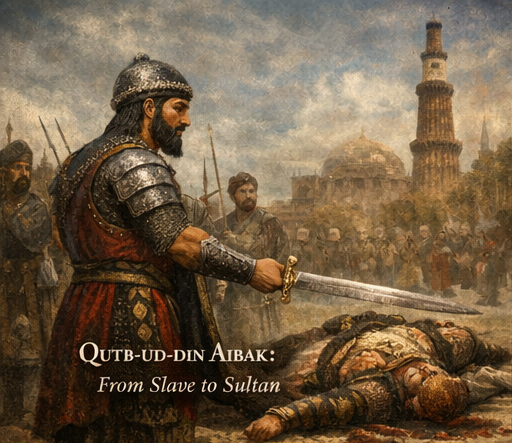
This dynasty began in 1206, after the death of Muhammad Ghori. His successor declared Ghori’s most loyal slave and lieutenant general, Qutb-ud-din Aibak, as the first Sultan of Delhi.
Since Qutb-ud-din Aibak himself had once been a purchased slave, he was kind-hearted and generous. After winning battles, he often distributed wealth among the people. Because of this generosity, people lovingly called him “Lakh Baksh” (the giver of lakhs).
He also left behind some historical monuments for us that people from all over the world come to see today, such as the world-famous Qutub Minar, Quwwat-ul-Islam Mosque, and Adhai Din Ka Jhopra mosque.
His rule was prosperous, but after ruling for only five years, in 1210, Aibak died when he fell from his horse while playing polo.
After this, in 1211, his son-in-law Shams-ud-din Iltutmish took over the throne. If we look closely, the real foundation of the Delhi Sultanate was actually strengthened by Iltutmish. During his reign, he made a major change by shifting the capital from Lahore to Delhi.
And since we are talking about the Delhi Sultanate, the capital being Delhi was very important. Unlike his father-in-law, Iltutmish did not focus much on expanding his empire. Instead, he paid more attention to solving the internal problems of his state.
His policy focused more on stability and consolidation rather than expansion and conquest. Although he did not attack other kingdoms, he also never allowed anyone to attack his own kingdom.
In history, he is especially known for preventing Genghis Khan from invading India. And you probably already know how powerful a ruler Genghis Khan was. If you don’t know, we have made a detailed video about him—you can watch it after this video by clicking the “i” button above.
But coming back to the point, Iltutmish was also known for bringing many constructive changes for the welfare of his people. For example, he created a governing body known as the “Chalisa” (Council of Forty), which functioned somewhat like today’s Council of Ministers. In his court, forty important nobles used to sit and advise the Sultan on major state decisions.
Not only this, he also introduced a system for his army in which soldiers were paid according to their rank and position.
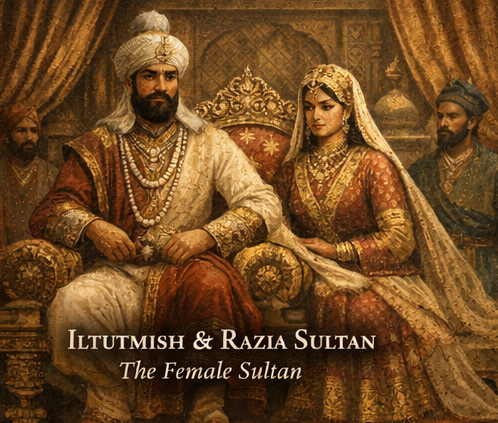
After his death, the throne of the Delhi Sultanate passed to his eldest daughter Razia Sultan. She became the first and only female Sultan of Delhi. However, just like today, many people at that time were jealous of a woman’s success and often ignored her good work. When Razia became Sultan, many people opposed her rule. After only about four years of reign, in 1240, she was defeated and killed.
After this, several Sultans came and went, but none of them were able to properly control the throne of Delhi.
Then in 1266, a powerful and strict ruler named Ghiyas-ud-din Balban came to the throne of the Mamluk dynasty and managed to keep strong control over Delhi for many years. As soon as Balban came to power, he abolished Iltutmish’s Chalisa system, placed spies across the kingdom, and built a very powerful army.
Balban did not consider himself just a Sultan; he believed himself to be “Zill-e-Ilahi” (the Shadow of God). Anyone who opposed him would almost certainly face death.
However, even Balban could not completely stop the Mongol invasions that troubled the region in the later years. After Balban’s death, his 17-year-old grandson, Kaiqubad, was made the new Sultan. But he was weak and ineffective. Taking advantage of his weakness, a noble named Jalal-ud-din Khalji killed him in 1290.
Kaiqubad had already died, and his son was only three years old. Jalal-ud-din Khalji seized the throne, ending the Mamluk (Slave) dynasty, and the rule of the Khalji dynasty began in Delhi
The Khalji Sultanate was considered one of the most powerful, fearsome, and authoritarian dynasties. From 1290 to 1320, it spread terror across much of India by defeating and looting many kings and kingdoms. The Khalji Sultanate was the only Delhi Sultanate that managed to extend its influence from the throne of Delhi all the way to the southern parts of India and as far as Bengal.
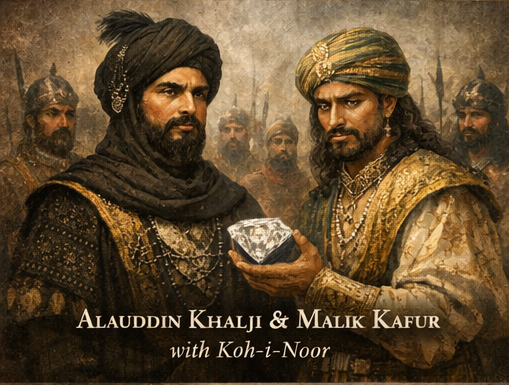
After ending the Mamluk (Slave) dynasty, Jalal-ud-din Khalji ruled until 1296. He was known as a humble and kind ruler for his people. However, he was about 70 years old, and taking advantage of the situation, in 1296 his nephew and son-in-law Alauddin Khalji killed him and seized the throne.
According to historians, the real expansion of the Khalji Sultanate happened under Alauddin Khalji. He was both a powerful ruler and a ruthless conqueror. During his reign he conquered or attacked several regions such as Gujarat, Ranthambore, Chittorgarh, Devagiri, Warangal, and Madurai.
In 1308, his general Malik Kafur brought the world-famous Koh-i-Noor diamond from Warangal after defeating its ruler.
Along with military campaigns, Alauddin ruled for about 20 years and is said in many accounts to have forced large numbers of people to convert to Islam, punishing those who refused. However, he also introduced several administrative reforms. He implemented price control policies to reduce the cost of daily goods, developed markets, and most importantly kept the Mongols from invading India during his reign.
He also built the famous Alai Darwaza in Delhi, which tourists still visit today.
Alauddin’s personal life is also discussed in historical debates. Some sources claim he had a special attachment to his general Malik Kafur. His royal household (harem) reportedly contained tens of thousands of people.
Eventually, Alauddin Khalji’s reign ended. Some historians say he was killed by Malik Kafur in a conspiracy to seize power, while others believe he died from illness. The exact truth remains uncertain.
After his death, his six-year-old son Shihab-ud-din Umar was made Sultan, but because he was so young, the real power remained with Malik Kafur. Soon, Alauddin’s other son Qutb-ud-din Mubarak Shah and several nobles plotted against Malik Kafur and killed him. Mubarak Shah then removed his younger brother from the throne and became Sultan himself.
However, Mubarak Shah proved to be even more irresponsible than his father. Historical accounts describe him as being frequently drunk and indulging in luxury and excess. Eventually he was killed by his general Khusrau Khan.
Khusrau Khan’s rule did not last long. Soon Ghiyas-ud-din Tughlaq defeated him and founded the Tughlaq dynasty in 1320.
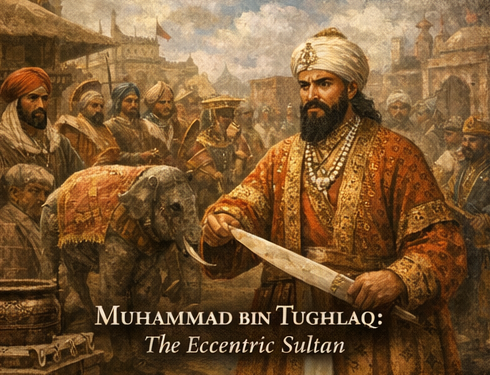
The Tughlaq dynasty ruled Delhi for about 90 years (1320–1414). One of its most famous and controversial rulers was Muhammad bin Tughlaq, often considered a very strange or eccentric Sultan. This reputation came from his unusual decisions.
He once decided to shift the capital from Delhi to Daulatabad (Devagiri) because the Mongols were repeatedly attacking Delhi. He ordered many nobles and citizens to move there. However, after the move, Delhi became vulnerable and nearly fell to Mongol attacks. Realizing his mistake, Muhammad bin Tughlaq ordered everyone to move back to Delhi. This massive migration caused huge suffering and many people died.
He also introduced token currency made of copper and brass instead of gold and silver. Because the metal was cheap, people started making fake coins, which damaged the economy. Eventually he had to withdraw the policy and return to gold and silver coins.
After his death, the throne passed to Firoz Shah Tughlaq, who proved to be a capable ruler. He built many cities such as Firozabad, Hisar, Jaunpur, and others. He also established the Dar-ul-Shifa hospital in Delhi, where patients were treated free of cost. He introduced welfare measures like helping poor girls get married, providing employment, and giving pensions to the elderly.
After ruling for about 37 years, Firoz Shah Tughlaq died. After his death, there was no strong ruler left in Delhi. Taking advantage of this weakness, in 1398, the Mongol ruler Timur (Tamerlane) attacked Delhi. The Sultan at that time fled in fear.
Within just five days, Timur’s army caused massive destruction in Delhi. Around 200,000 people were killed, many were looted, and countless women and children were abused or taken captive. It took Delhi nearly a century to recover from this devastation.
Timur himself was not interested in ruling Delhi, so he left and appointed Khizr Khan as governor. This marked the end of the Tughlaq dynasty and the beginning of the Sayyid dynasty (1414–1451), which was considered the weakest Delhi Sultanate.
After the death of Khizr Khan, no strong ruler emerged. The last Sayyid ruler Ala-ud-din Alam Shah eventually abandoned the throne, and power passed to Bahlul Lodi, beginning the Lodi dynasty.
The Lodi dynasty was the first Afghan dynasty to rule Delhi. After Bahlul Lodi’s death, the most capable ruler of this dynasty was his son Sikandar Lodi, who founded the city of Agra and made it his capital.
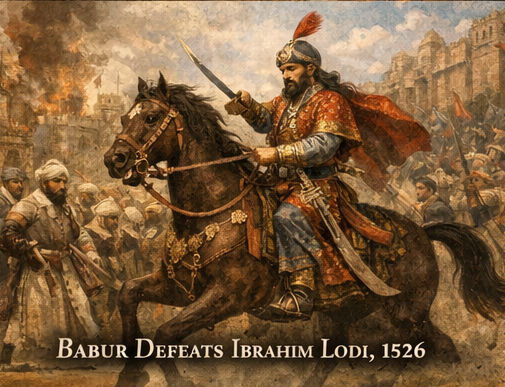
However, his son Ibrahim Lodi, the last Sultan, had an arrogant and angry nature. His ministers and nobles disliked him because he often executed people merely on suspicion. Because of this, his governor Daulat Khan and his uncle Alam Khan invited the ruler of Kabul, Babur, to invade India and defeat Ibrahim Lodi.
In 1526, Babur defeated Ibrahim Lodi in the First Battle of Panipat, ending the Delhi Sultanate and establishing the Mughal Empire, which would rule India for the next several centuries.
One thing becomes clear from this entire story: power often became more important than family relationships, and many rulers even killed their own relatives in the struggle to capture the throne of Delhi.
But why was Delhi so important?
Even during the time of the Rajputs, Delhi was a major commercial center where traders from across the country came to do business. Coins were also minted there, making it one of the richest cities. During the Delhi Sultanate, rulers governed many regions of India from Delhi. Therefore, whoever controlled Delhi could easily control many other parts of the country.