Oldest universities in the world
Nalanda—this is a name you must have heard at some point, or perhaps read about in your books. Nalanda may sound like a small name, but the history behind it, its achievements, and its stature are immense. Today, there are countless international schools, colleges, and universities around the world, but the title of being the world’s first international university belongs to Nalanda.
Today, where Indian students prefer going abroad for higher education, there was once a time when students from all over the world came to India—specifically to Nalanda—because it was one of the most renowned centers of learning in the world. It was considered a center of excellence in its time. Built like a Buddhist monastery, this university was more than 500 years older than Oxford and even Europe’s oldest-known university, the University of Bologna
The story of its existence dates back about 1500 years, when it was known as a world-famous university in the Indian state of Bihar—Nalanda Mahavihara. It was among the world’s earliest residential universities and is also counted among the greatest and oldest universities in history. Sadly, today we cannot see it in its full form; only its ruins remain. Once, students from across the world came here to study, and today people from around the world come to see its remains.
The remains of Nalanda have been preserved in a museum, bearing witness to a time when Nalanda Mahavihara was at the peak of its progress. The question is—what made Nalanda so special, so famous, and so important? What happened that it suddenly disappeared from India? How did Nalanda decline? Who was responsible? What did Nalanda contribute to India, and what did we lose with its fall? We will explore all this and much more about Nalanda University in today’s documentary titled “Nalanda University.” Ancient Nalanda University
Nalanda Mahavihara, or Nalanda University, holds a prominent place in Indian history as a center of ancient education. It has great historical significance and is one of the oldest universities in the world. Spread across approximately 14 hectares, Nalanda remained the largest center of education in the world for nearly 700 years after its establishment.
Built on the Mahavihara system, this university functioned like a residential complex where students lived and studied Buddhist teachings and philosophy. The name “Nalanda” itself is meaningful—it comes from three Sanskrit words: “Na,” “Alam,” and “Da,” meaning “an unstoppable flow of knowledge.” Similarly, “Mahavihara” means a grand monastery—thus, Nalanda Mahavihara was a grand residential institution for Buddhist scholars that nurtured seekers of knowledge.
Nalanda was one of three major learning centers in ancient India established between the 4th and 9th centuries—the other two being Takshashila and Vikramshila. Takshashila was the earliest and is now located in Pakistan. Renowned scholars like Chanakya and Panini taught there. It followed the Gurukul system and taught Vedic literature, Vedangas, and Upanishads.
Vikramshila University, located in Bhagalpur district of Bihar, was another prestigious institution established in the 8th century by King Dharmapala. Students from both India and abroad came there to study. Like Nalanda, it too was a Buddhist monastery.
Nalanda, located in the Magadha empire near present-day Bihar Sharif, about 95 km southeast of Patna, is now a UNESCO World Heritage Site. It remained a center of learning from the 5th century CE to around 1200 CE. It is believed that Buddha visited this place multiple times, making it an important center of Buddhist learning.
Nalanda was established during the Gupta Empire in the 5th century CE by Emperor Kumaragupta I, aiming to create a global center of knowledge. The Gupta period proved to be a golden era for Nalanda, marked by advancements in art, science, and literature. The university flourished and expanded greatly during this time.
Its infrastructure grew with numerous buildings, libraries, lecture halls, and residential quarters for teachers and students. The goal was to provide all facilities and attract more learners, thereby spreading knowledge globally.
Nalanda continued to grow under rulers like Harshavardhana in the 7th century and later under the Pala dynasty, which expanded its buildings and promoted it internationally. Scholars from across Asia came to study here.
However, despite its greatness, Nalanda could not survive forever. Today, only its ruins remain, hinting at its past grandeur. Much of what we know about Nalanda comes from Chinese travelers like Xuanzang (Hiuen Tsang) and Yijing, who studied there and documented their experiences in detail.
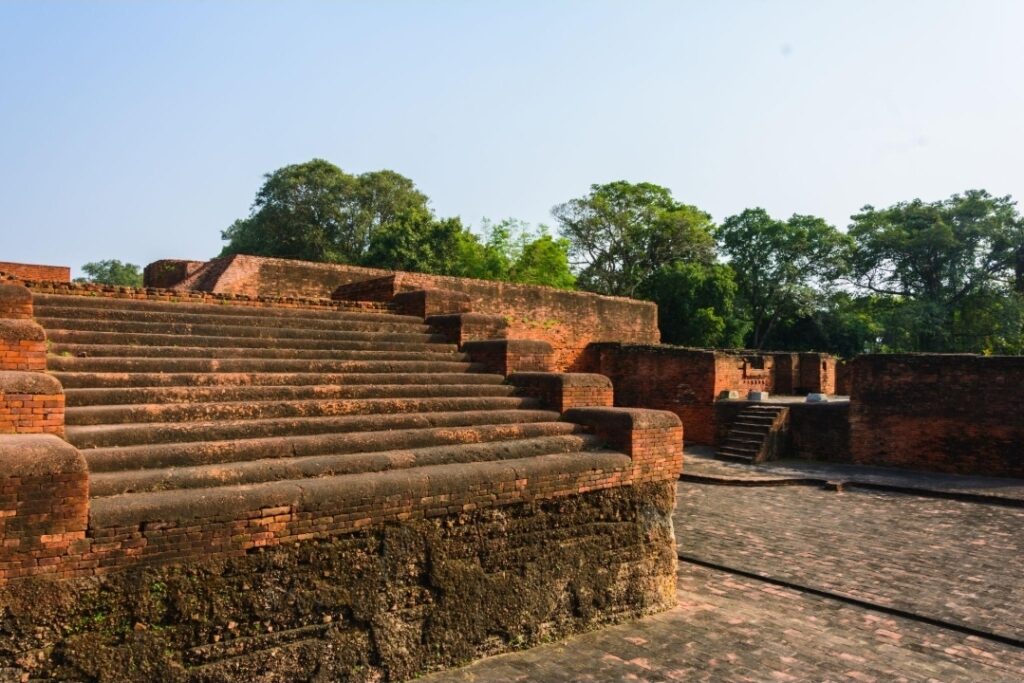
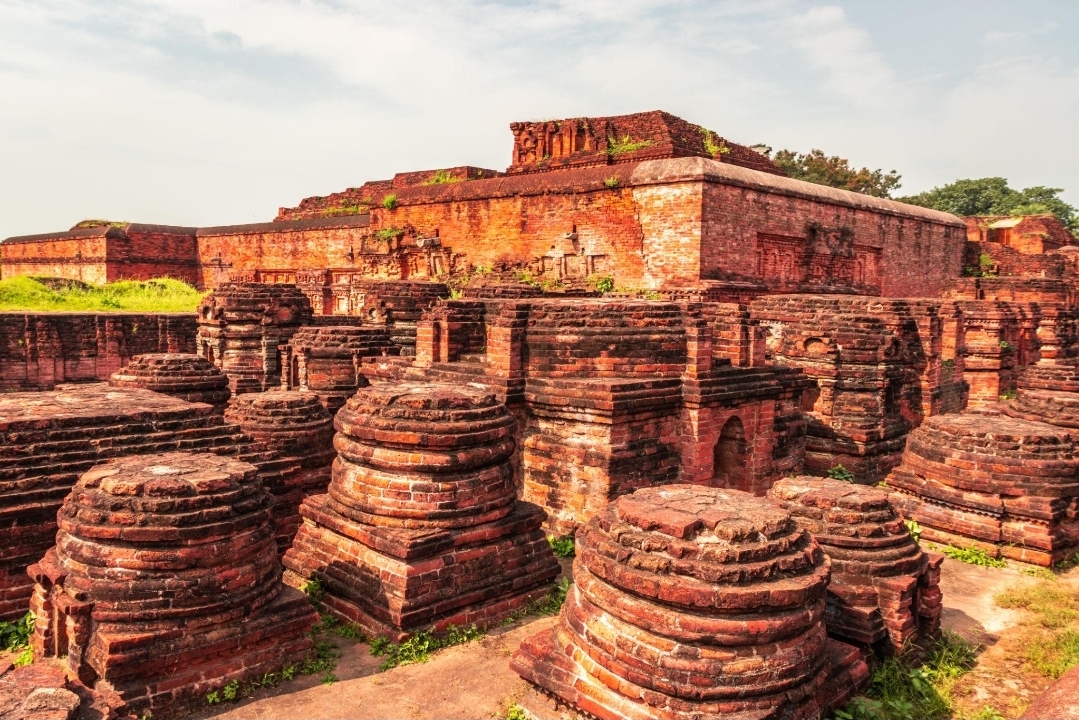
According to their accounts, Nalanda housed around 10,000 students and 2,000 teachers. It was an architectural masterpiece made of red bricks, with tall walls and grand gates. The campus included temples, stupas, classrooms, meditation halls, lakes, and gardens.
Students lived in small rooms with natural insulation, and the campus had multiple departments like history, ecology, Buddhist studies, philosophy, and comparative religion. Education and accommodation were free, but admission required passing a rigorous entrance test—even the gatekeeper tested candidates.
The teaching methods included lectures, debates, and discussions to enhance critical thinking. The teacher-student ratio was about 1:7, ensuring personalized attention.
Nalanda produced great scholars like Nagarjuna, Aryadeva, Shantideva, Dharmakirti, and Vasubandhu. Aryabhata, the father of Indian mathematics, was also associated with Nalanda and is credited with recognizing zero as a number.
Initially focused on Buddhist studies, Nalanda later expanded to include subjects like architecture, medicine, grammar, and mathematics. Its curriculum was innovative, allowing students to choose subjects based on their interests.
One of Nalanda’s greatest features was its library, Dharmaganja, meaning “Mountain of Knowledge.” It was a nine-story building divided into three sections and housed over 300,000 books.
Despite its greatness, Nalanda faced multiple attacks. The first was by the Huns (455–470 CE), the second by the Gauda rulers in the 7th century, and the third—and most devastating—was in 1193 CE by Bakhtiyar Khilji.
Khilji’s attack led to massive destruction. The university was burned, thousands of monks and students were killed, and the library burned for nearly three months. This marked the end of Nalanda.
A tragic story associated with Khilji tells how he was cured by an Ayurvedic scholar, Rahul Shribhadra, using a clever method involving medicinal application on Quran pages. Instead of gratitude, Khilji became envious and ordered the destruction of Nalanda.
Chinese traveler Xuanzang managed to save some manuscripts and took them to China, preserving a fraction of Nalanda’s knowledge.
After centuries of obscurity, Nalanda was rediscovered in the 19th century by Francis Buchanan-Hamilton and later identified by Alexander Cunningham. Excavations revealed only about 10% of the original site.
In recent years, efforts have been made to revive Nalanda. It was declared a UNESCO World Heritage Site, and a new Nalanda University was established in 2014 near the original site, continuing its legacy with modern advancements.
Nalanda remains a symbol of India’s rich intellectual heritage. As the Dalai Lama once said, much of Buddhist knowledge comes from Nalanda.
This documentary ends here, but it leaves us with an important question—shouldn’t we take pride in such a glorious past, respect our knowledge, and contribute to its growth?
Nalanda University Ruins ( Ancient Mahavihara )