

Stone Age / पाषाण युग
There were three types of Stone Age which are as follows:
पाषाण युग के तीन प्रकार थे, जो निम्नलिखित हैं:
- Old Stone Age (पुराना पाषाण युग)
- Middle Stone Age (मध्य पाषाण युग)
- New Stone Age (नव पाषाण युग)
Types of Stone Age
Paleolithic Period or Old Stone Age / पुरापाषाण काि या पुराना पाषाण युग
(30,000 BCE–10,000 BCE)
Mesolithic Period or Middle Stone Age / मेसोलिधथक काि या मध्य पाषाण युग
(10,000 BCE–8,000 BCE)
Neolithic Period or New Stone Age / नवपाषाण काि या नया पाषाण युग
(8,000 BCE–3,000 BCE)
Hunting was the main living source of Old Stone Age. / लिकार पुरापाषाण युग का मुख्य जीवन-ननवाह साधन था।
Around 36000 B.C. Back human had become in form. It is also known as Homo-Sapiens. / लगभग 36000 ई.पू. तक मनुष्य का स्वरूप नवकलसत हो चुका था। इसे होमो-सेकपयन्स कहा जाता है।
The first pet of human was Dog which was in Middle Stone Age.
मनुष्य का पहिा पाितू जानवर कु त्ता था, जो मध्यपाषाण युग में पाितू बनाया गया।
Human knew about fire from Old Stone Age but it had become in use by New Stone Age.
मनुष्य को अग्नि के बारे में जानकारी पुरापाषाण युग से थी, िेककन उसका उपयोग नवपाषाण युग मेंप्रारंभ हु आ।
Firstly The institute of Stone Age Culture was established by Robert Boose Foot in India (1863). / भारत में पाषाण युग संस्कृ नत का संस्थान सववप्रथम रॉबर्व ब्रूस फू र् द्वारा सन् 1863 में स्थाकपत ककया गया।
Bone weapons were found from Bihar in New Stone Age. / अस्थस्थ से बने औजार नवपाषाण युग मेंनबहार सेप्राप्त हु
ए।
The first metal used in weapons was Copper, moreover human knew the first metal named as Copper. / सबसे पहिे हधथयारों में लजस धातुका उपयोग हुआ वह तांबा था, और मनुष्य ने सबसे पहिे लजस धातु को पहचाना उसका नाम तांबा था।
Wheel was introduced in New Stone Age. / पहहये का
प्रयोग नवपाषाण युग मेंप्रारंभ हु
आ।
- Agriculture was introduced in New Stone Age. / कृषि का प्रारंभ नवपाषाण युग में हुआ।
- Firstly the clues of Agriculture was found from Mehargarh (west of Indus river). / कृषि के प्रथम प्रमाण
मेहरगढ़ (लसंधु नदी के पलिम में) से नमिे।
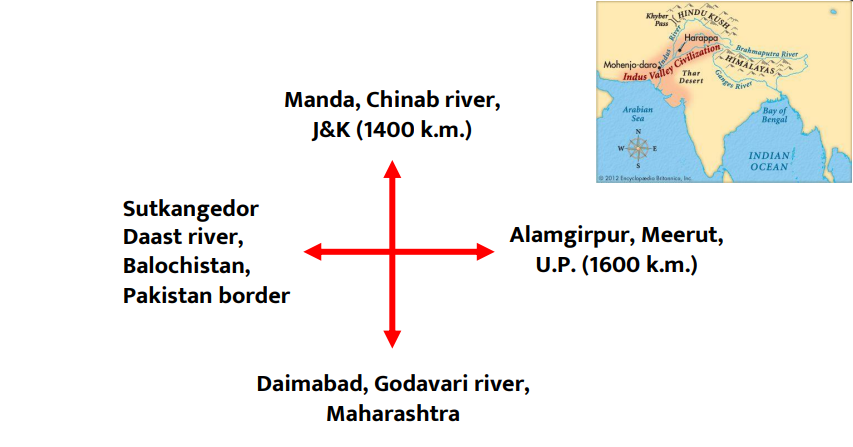
| Indus Valley Civilization (3300 to 1300 BCE) |
| Early Phase (3300 to 2600 BCE) | Mature Phase (2600 to 1900 BCE) | Late Phase (1900 to 1300 BCE) |
| Early sites of IVC are | Occupied area of over 8 lakh sq km | IVC declined. Sites are more in number but they are smaller in size. |
| Padri (Gujarat), Kalibangan (RJ), Dholavira (Kutch), Harappa (Pak), Balakot, Amri, and Bhirrana (Haryana), Kot Diji and Gumla | Divided into 5 phases (zoom in the map below). आईवीसी में गिरावट आई है। साइटों की संख्या तो बढ़ी है, लेककन उनका आकार छोटा है। 5 चरणों में ववभाजजत (नीचे दिए िए मानचचत्र को ज़ूम इन करें)। |
Harappa
Location : (Montgomery) Punjab
- River: Ravi
- Year: 1921
- Excavator: Dayaram Sahni
- Findings: Granaries, coffin burial, important Indus Valley Civilization town, first town which was excavated and studied in detail
Mohanjodaro
Location : Sindh, Pakistan
- River: Sindhu (Indus)
- Year: 1922
- Excavator: Rakhal Das Banerjee
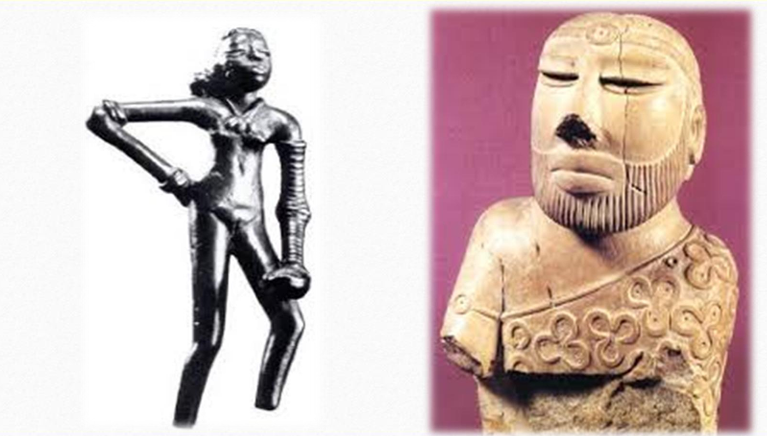
- Findings: Great Bath (the biggest bath ghat),
Great granary, Bronze dancing girl, Bearded
man, terracotta toys, Bull seal, Pashupati
seal, three cylindrical seals of the Mesopotamian type, a piece of woven cloth
Chanhudaro
- Location : Sindh, Pakistan
- River: Sindhu
- Year: 1934
- Excavator: Gopal Mazumdar
Chanhudaro - Findings: Bead making factory,
use of lipstick, Black liner, Comb
Ropad
- Location : Punjab
- River: Sutlaj
- Year: 1953-55
- Excavator: Yagyadutta Sharma
- Findings: Dog buried with Men
Lothal
- Location : Ahamadabad, Gujarat
- River: Bhogwa
- Year: 1955-62
- Excavator: Rangnath Rao
- Findings: Bead making factory,
dockyard, button seal, fire altars,
painted jar, earliest cultivation of
rice, Set of Elephant Teeth
Kalibanga
- Location : Sriganganagar, Rajasthan
- River: Ghaggar
- Year: 1961
- Excavator: Brij Basi Lal, Bal Krishna
Thapar - Findings: Baked/burnt bangles, fire
altars, Shiva Lingam, small circular pits
containing large urns and
accompanied by pottery, bones of
camel
Dholavira
- Location : Kutch, Gujarat
- River: Ghaggar
- Excavator: J P Joshi
- Year: 1960
- Findings: Bullocks and driven by a
nude human, Water harvesting
and number of reservoirs, use of
rocks for constructions
Banawali
- Location : Fatehabad, Haryana
- Excavator: Dr. R.S.Bisht
- Year: 1975/ 1983-84
- Findings: Barley, terracotta
figure of plough
Larkana
- Location : Larkana District, Punjab
- Excavator -RD Banerjee
- Year: 1922
- River: Sindhu
- Findings: Barley
Rakhigarhi
- Location : Hisar, Haryana
- Year: 1997 to 2000
- Excavator- Amarendra Nath
- Findings: Terracotta wheels, toys,
figurines, pottery. Large site
Alamgirpu
- Location : Meerut, UP
- River: Hindon
- Year: 1958
- Excavator- YD Sharma
- Findings: Impression of
cloth on trough
Sutkagendor
- Year of Excavation -1927
- Excavator -RL. Stein
- Situated in Baluchistan on
Dast river - Trade point between
Harappa and Babylon, to
mature phase.
Mostly asked Questions
Most populated site of indus valley civilization: Daimabad
Most modern site of indus valley civilization: Mohanjodaro
Biggest site of Harappan civilisation: Rakhigarhi (Hisar/ Haryana)
Largest City of IVC: Mohanjodaro (around 300 hectares)
IVC People know the use of Gold, Silver, Copper, Bronze but not Iron
IVC people had trade relation with: Mesopotamia
