
Jainism Introduction
Today I want to tell you about a period in Indian history that changed Indian society completely. This time had an effect on the way people believed and also changed the way the country was ruled and how the economy worked. Even Mahatma Gandhi, who believed strongly in non-violence got some of his ideas from this time. This is the story of the 5th centuries before Christ. It was a time when the Vedic culture of times was at its highest point. People started to question the class and the old customs and rituals.
This happened in the areas of Panchala and Videha where the Upanishads were written around 600 BCE. These texts talked about ideas and questioned the importance of rituals. They put focus on learning and understanding. As the Vedic era ended big changes happened. New kingdoms called Janapadas appeared. These kingdoms were ruled by Kshatriya kings. Fighting was no longer about taking animals. Taking over land had become very important. Some say the Mahabharata war happened during this time. People who lived by herding animals started to become farmers. During this time many different religious groups appeared in the part of the Gangetic plains. Some say, up to 62 groups came into existence. Of all these groups Jainism and Buddhism were the important.
Causes of Origin Jainism
In todays story we will focus on Jainism. Let us first understand the reasons behind the emergence of these orders. In the Vedic period society was divided into four varnas. This division gradually became rigid. Naturally this varna system created tension within society. While it is difficult to know how the Vaishyas and Shudras reacted to this the Kshatriya class certainly began to speak out against Brahminical dominance. They started a form of protest movement that challenged the idea that birth determined one’s status in the varna system. This strong reaction from the Kshatriyas was one factor behind the origin of religions.. The real cause for their rise was the spread of a new type of agricultural economy in northeastern India. By the end of the century BCE the use of iron had begun in eastern Uttar Pradesh and in northern and southern Bihar. This made it easier to clear forests. As a result people settled there in numbers marking the beginning of widespread agriculture. Around 500 BCE numerous cities began to emerge in India such as Kaushambi, Kushinagar, Varanasi, Vaishali, Chirand, Taradih, Pataliputra, Rajgir and Champa and Vardhamana Mahavira was associated with many of them. It was during this period that coins the ‘punch-marked’ variety first came into use for trade and commerce.
The use of coins fostered growth in trade thereby increasing the societal importance of the Vaishya class. Naturally the Vaishyas sought a religion that could elevate their standing. This is why they supported Mahavira. There were reasons for this support. First Jainism did not initially emphasize the varna system. Second Jainism advocated non-violence, which would help end wars and thereby facilitate trade and commerce. Third Brahminical law books, such as the Dharmasutras condemned the practice of money-lending. As a result traders began to be looked down upon. Consequently the trading class sought religious paths to elevate their social status. Meanwhile traditionalists in society yearned for the way of life much like those who struggled to accept the changes brought about by the Industrial Revolution. They were uncomfortable with styles of clothing the concept of private property and modern housing designs preferring instead a primitive lifestyle. Jainism’s emphasis, on a pure and ascetic way of life appealed to many contributing to the rise of such new religions.
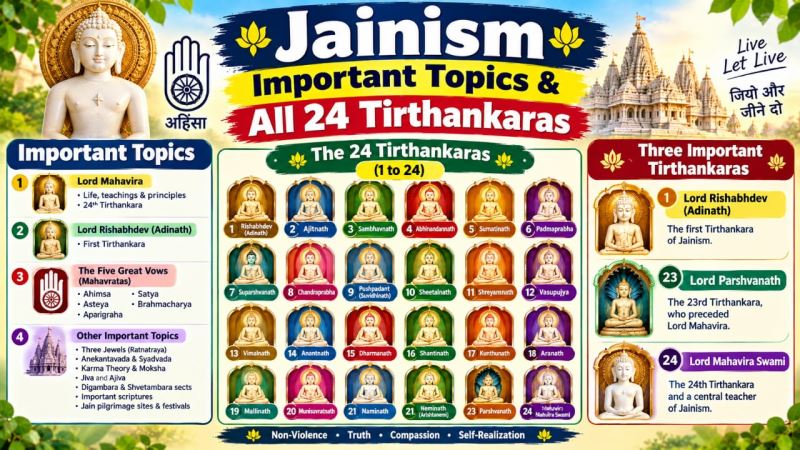
Mahavira is considered the founder of Jainism. I find that according to Jain belief Mahavira, the significant religious teacher was preceded by twenty‑three predecessors known as Tirthankaras. Jains believe that Rishabhdev was the first Tirthankara and the founder of Jainism; Rishabhdev is said to have hailed from Ayodhya. If Mahavira is regarded as the twenty‑fourth Tirthankara then the origins of Jainism would date back to around the 9th century BCE whereas the settlement of Ayodhya began in 500 BCE; consequently establishing the authenticity of Rishabhdev’s existence is difficult. The historicity of the other Tirthankaras is also highly questionable. The core teachings of Jainism originated with Parshvanatha, the twenty‑third Tirthankara. Parshvanatha, a native of Banaras renounced life to become an ascetic. However historians generally regard Vardhamana Mahavira Parshva’s successor as the true founder of Jainism. While the exact dates of Mahavira’s birth and death cannot be determined with certainty tradition holds that Mahavira was born in 540 BCE in Vaishali (located in the present‑day district of Bihar).
Mahavira’s father, Siddhartha was the head of a Kshatriya clan and Mahavira’s mother was Trishala of the Licchavi. Chetak’s sister was married to Bimbisara; this clearly indicates that Mahavira’s family was connected to the family of Magadha, which facilitated Mahavira’s access to princesses and nobles. Initially Mahavira led a householder’s life. At the age of 30 Mahavira renounced the world to become an ascetic in pursuit of truth. Mahavira spent 12 years practicing penance never staying in any village or town for more than a few days. It is said that throughout this 12‑year journey Mahavira never changed his clothes and upon attaining Kevala or omniscience at the age of 42 Mahavira completely renounced clothing. Through Kevala Mahavira conquered misery and attained happiness; this conquest earned Mahavira the titles of Mahavira (Great Hero) and Jina (Conqueror of Self). Mahavira’s followers came to be known as Jainas. For 30 years Mahavira. Expanded Jainism, a mission that took Mahavira to cities such as Kaushambi, Magadha, Mithila and Champa. Mahavira passed away attaining Nirvana at the age of 72 in Pavapuri (located in the Nalanda district of Rajgir, Bihar). Now let us move forward and take a look, at the doctrines or principles of Jainism.
Doctrine of Jainism
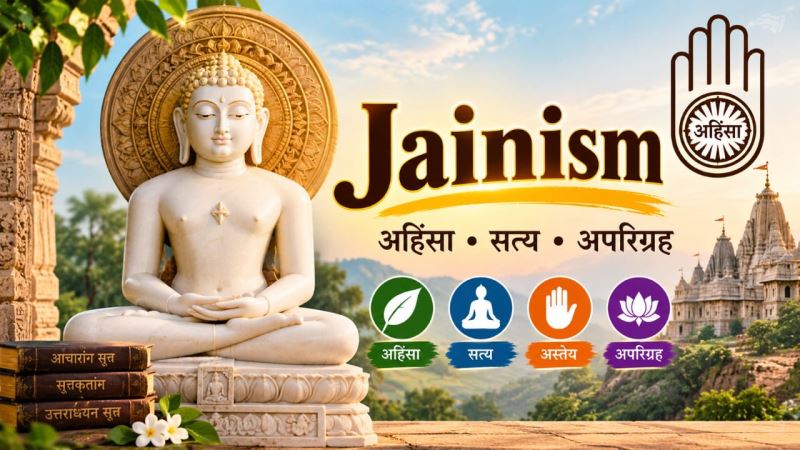
Jainism teaches five core principles. The first is to avoid violence, known as non-violence. The second is truthfulness do not tell lies. The third is non-stealing; do not take what is not given. The fourth is non-possession meaning do not hoard or accumulate wealth. The fifth is continence or celibacy. It is believed that Mahavira added the fifth principle celibacy while taking the other four from earlier Tirthankaras. Among all these teachings the important one in Jainism is Ahimsa which means non-injury to any living creature.
Before Mahavira Parshva had asked his followers to cover their lower bodies with clothing.. Mahavira went further. He told his followers to give up clothes. This shows he wanted a stricter and simpler way of life. His strict approach led to a split in Jainism on. One group, the Shvetambaras chose to wear clothes. The other group, the Digambaras rejected clothing entirely. Believed it was necessary for true spiritual discipline.
Jainism does recognize the existence of God.. Gods are placed below the Jina in spiritual rank. A Jina is someone who has conquered passions and achieved liberation. This is different from Buddhism, which generally does not accept the idea of a soul or divine beings. Jainism did not oppose the Varna system outright. According to Mahavira, a person’s position in society whether low depends on karma. That is past actions determine circumstances. Good deeds lead to rebirth in castes bad deeds lead to lower ones.. Mahavira also said that even people born into lower castes could reach liberation through pure living. Liberation means freedom from the cycle of birth and death. It is not about status. It is about the soul being freed from bonds.
To achieve liberation no rituals were needed. Instead three things were essential: Right Knowledge, Right Faith and Right Action. These together are called the Triratna or Three Jewels. They form the foundation of the Jain path. Without them no progress could be made.
Because Jainism strongly believes in Ahimsa many activities were considered harmful. War was banned, because war causes killing. Agriculture was also prohibited. Growing crops involves harming creatures like insects and worms. So because of this belief Jains avoided farming and warfare. As a result most Jains turned to trade and business. Their focus shifted to professions where harm, to life could be minimized. This is why Jain communities became prominent in commerce across India.
Spread of Jainism
Now let us talk about how Jainism spread. To share the teachings Mahavira created a group of followers that included both men and women. He shared his ideas with people using the Prakrit language. It is believed that he had 14,000 followers this was not a very big number. Jainism kept growing, in places where the power of the Brahmanical religion was not strong. When it comes to how Jainism reached Karnataka, Chandragupta Maurya, the leader of the Mauryan Empire is often mentioned as a main person but there is not clear proof of this. Another reason given for the spread is a famine in Magadha, which happened two years after Mahavira died. This famine went on for 12 years. To run away from it some Jains moved to South India led by Bhadrabahu, which helped spread the religion.
Those who stayed in Magadha followed Sthulabahu. Once the famine was over problems started between the two groups about the ideas of Jainism. A meeting was held in Pataliputra to fix these problems and collect the teachings of Jainism but the Jains from the South did not take part. Later the group from the South became known as the Digambaras and the group from Magadha became known as the Shvetambaras; this is how Jainism split into two groups. Even if the story, about the famine is not completely certain it is clear that Jainism did split into two groups. It is also important to know that a later meeting happened in 512 AD, led by Kshama Shramana, where the 12 Angas and 12 Upangas important religious books of Jainism were put together. According to written records Jainism reached Karnataka after the 3rd century AD; after that many Jain monasteries (basadis) were built there starting from the 5th century AD.
Jainism was around early as the 4th century BC and in the 1st century BC it got support from King Kharavela of Kalinga. The spread of Jainism in the parts of Tamil Nadu happened during the 2nd and 1st centuries BC. In years Jainism moved into Malwa, Gujarat and Rajasthan where many Jains still live today. Trade and business are still their jobs. An interesting thing to note is that even though Jainism did not grow fast as Buddhism the Jain community has stayed strong while Buddhism almost disappeared from this area. Let us also think about what Jainism has done for society.
Jainism was the real effort to challenge the Varna system and the ritual-based Vedic religion. Early Jains did not use Sanskrit, which was controlled by the Brahmins and instead used Prakrit, the language of people to share their ideas. Their religious books were written in Ardhamagadhi. Were gathered and put together in Vallabhi in Gujarat in the 6th century AD. This helped Prakrit grow and develop. Many other languages came from Prakrit like Shauraseni, from which Marathi came. Early Jains also created writings in the Apabhramsha language and made the first grammar for that language. During the medieval period Jains wrote many books in Sanskrit too and in the end they helped create the Kannada language. Jainism also contributed a lot to art and architecture. It grew at the time as Buddhist and Hindu architecture and then it found its own unique style.
Many temples were built, in Western India. The Udayagiri and Khandagiri caves in Odisha, built by King Kharavela between 193 and 170 BCE are examples of Jain architecture. You might have heard of the statue of Lord Gommateshwara also known as Bahubali, which’s the tallest single-stone statue in the world. In Rajasthan, the Dilwara Temples, built between the 13th centuries show amazing marble work and are dedicated to the Tirthankaras. We will talk more about Jain architecture in another video. For now let us also look at why Jainism declined or why it failed to attract people. There were reasons, for this and we will look into them.
Decline of Jainism
Regarding the decline of Jainism: first Jainism strongly opposed the Brahmanical religion, which caused the Brahmins to exclude it. A second reason was its rules; the ideas about non-violence were so extreme that farming was not allowed, which stopped the farming people from following the religion. Regular people found it hard to live by strict habits like fasting, giving up things and living a simple life. A third and maybe the important reason was that Jainism never got the same support from kings that Buddhism did; many rulers liked Buddhism but Jainism did not get the same kind of help. Finally the way the Jain Sangha was organized was very strict. The split that divided the religion into two groups also helped to bring about its decline. In conclusion we have seen how Jainism started as a group in political, social and economic situations and then became a full religion. Based on the beliefs of great Tirthankaras like Mahavira Jainism has continued to exist through every time, in Indian history even though it has a small number of followers.