

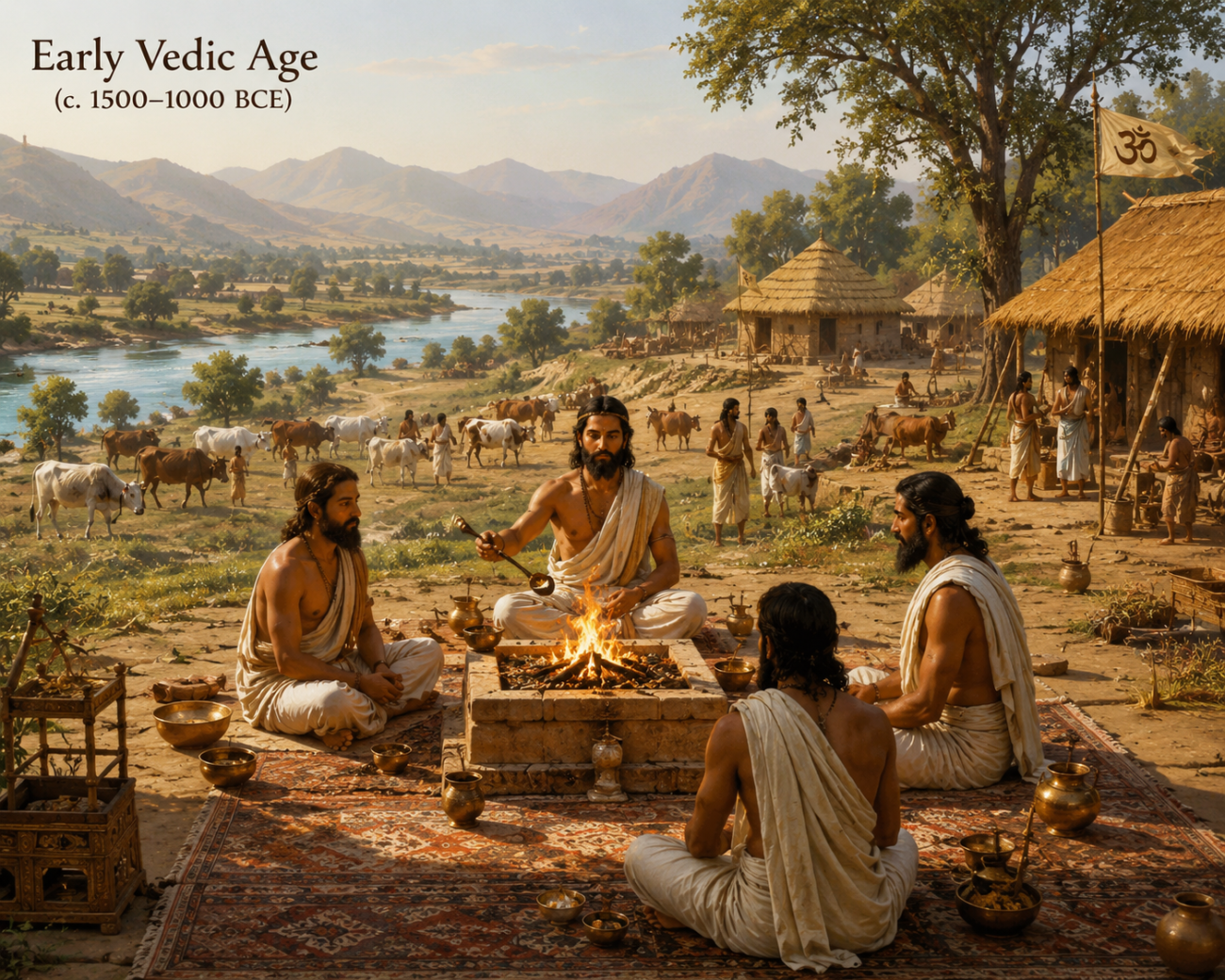
Early Vedic period: Today we will talk about an important period of ancient history, which started with the Indian migration of Aryans. The Indus Valley Civilization took place around 1500 AD. After this, the Vedic period emerged as the next major settlement. The Vedic civilization lasted from 1500 AD to around 500 AD, which is divided into two parts: Early Vedic period, which lasted from 1500 to 1000 AD. The Rig Veda was compiled in this period, hence it is also called Rig Vedic period. Late Vedic period, which took place from 1000 to 500 AD. Apart from the Rig Veda, other texts were composed in this period, such as the Trivedias, Brahmanas, Aranyakas, Upanishads. In this lecture, we will learn about the arrival of Indo Aryans in the Early Vedic period. Friends, the Rig Vedic period starts with the migration of Indo Aryans and Aryans. Information about the features of the Aryan civilization is found in the middle. In this text, Rigveda was based on gender. From where did the Aryans migrate? Different historians and experts have given different theories. Some believe that in the book Reaction Home in the Vedas, Bal Gangadhar Tilak placed the origin of Aryans in the Arctic region. It is also believed that Aryans entered India through the Khyber Pass of the Hindu Kush Mountains. Well, the most accepted theory is that Aryans came to India as immigrants. They lived in the borders of Eastern Afghanistan, North West Frontier Province, Punjab and West Indies Up. Mention of Afghanistan’s River Kumbh and Sindhu i.e. Indus River and its 5 distributors i.e. Jhelum, Chenab, Ravi, Vyas and Sutlej is found in the Rigveda, which was in the area of Haryana, Rajasthan. This entire region where Aryans initially settled is called the Land of Seven Rivers.
Now let’s take a look at the most important text of the Vedic period: the Rigveda. The Rigveda is the earliest of the Vedas. It has been added to the UNESCO World Heritage List. It contains 128 hymns, divided into 10 maṇḍas. The Rigveda is a collection of prayers dedicated to Agni, Indra, Mitra, Varuna, and other gods. Some families of Śupas and guṇḍas wrote these. Of the 10 maṇḍas, 5 through 7 are the earliest parts, while mas one and nine are the latest editions. As we mentioned earlier, references to Aryan culture are also found in other religious texts. So, before proceeding further, let’s take a look at this aspect as well. The Śupas are attributed to 900 to 800 AD. All these texts can be grouped into a cultural group that can be called Vedic Sanskrit. The Sanskrit we know today is derived from Vedic Sanskrit. Similar genetic signals can be seen in speakers of Indo-European languages. Similar genetic signals have been found in the Central Asian steppes and Indo-Aryan speakers. The horse was an important Aryan trait. In the Rigveda, it is called Ashva. Similar words are found in Sanskrit, Avestan, Greek, Latin, and other Indo-European languages. In this context, there are frequent mentions of horses and chariots in the prayers of Mitra. In the Rigveda, the god Mitra is also known as Alyor, and references to horses are also found in all texts, which are mentioned in the later Vedic texts. It was also a Greek practice, and Hummer has given a detailed description of it. In Sanskrit, Burj is called Urja, and similar words are found in six Indo-European languages. Creation was also an important Aryan trait. This practice is also seen in Vedic texts and Homeric texts, but no reference to it has been found in the mature Harappan texts. Now, fire worship is quite prominent in both this and the Rigveda. The cult of Soma, called Homo in the Byzantine language, is considered important. It was confined to the Iranian and Vedic peoples. We find many similar references in the Rig Veda and other religious texts.
Friends, the basis of the social structure of the Rig Vedic society was kinship. The family was the basic unit, and the head of the family was called the Kulpa. Each family was part of a larger group called the Vishva (family). Together, the largest social unit was the family. The family was a patriarchal family, meaning the father was the head of the family. Marriage was a later institution, and there is no evidence of child marriage. Sati and purdah systems were also absent in the Vedic society, meaning marriages were conducted with only one person at a time. However, some instances of polygamy have also been found. Society was not divided along caste lines, and occupation was not based on birth. People of different occupations also belonged to the same clan. There are also some instances of people’s physical appearance in the Rig Veda. In the initial stage, varna was associated with the color of the person. Color distinction is the possibility of the formation of a kind of social order. Power is a factor in social division. This can be said to be a conquest of indigenous tribes by the Aryans. The varnas are mentioned only in the Purusha Sukta of the Tenth Mandala of the Rigveda. From this, it can be inferred that the varna system was introduced in the later Rigvedic era. Social mobility was possible in the varna system of this time, and strict social hierarchy was absent. Let us see what the economic structure of the Rigvedic society was. References to the Rigvedic economy are found in the Rigveda. From this, it can be inferred that the Rigvedic people were a pastoral people. World capture was the only basic wealth. Land used for farming was not a well-established private property. Gold coins were called Niksha, which were a unit of gold. Coins were generally used only for large transactions.
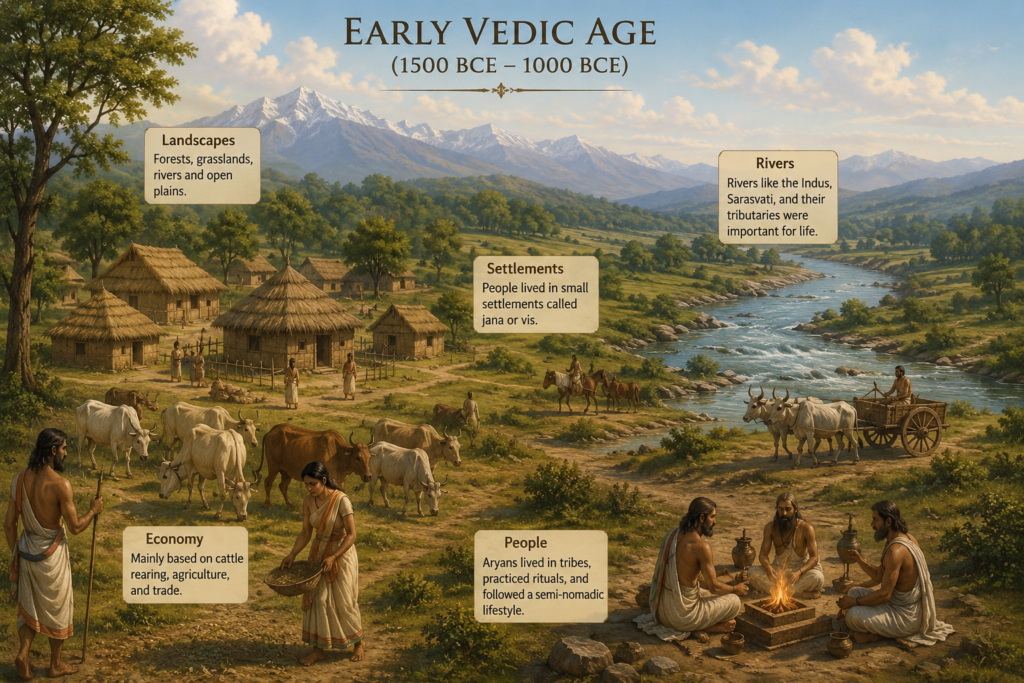
Trade mostly took place in a system, and the king was a valuable unit through which trade was possible. The kingdom functioned solely on voluntary offerings, as there was no regular revenue system. The Rig Veda also mentions various crafts, such as carpenters, charlatans, weavers, potters, leather workers, and gambling. Copper and bronze were popular pastimes. It is known that these were used in this era, although no evidence of iron technology has been found. Bullock carts, horses, and iron charlatans were used for transport, and some references to boats are also found. So, friends, this was about the basic aspects of Rig Vedic society, i.e., political, social, and economic aspects. Apart from these, another important aspect of every society is religion, which basically provides lessons to every society. Vedic Religion: The Vedic Aryans Maya Natural Forces, Such as Earth, Fire, Wind, Rain and thunder were worshipped. These natural forces were seen as different gods and were worshipped. They were worshipped since the middle of Yajna. Ideal worship and temples were not in existence. Prayers and sacrifices were the dominant mode of worship. It is important to know here that Aryans did not worship the gods for spiritual upliftment but for the food of their people and animals. Some of the references to worship in the Rigveda are as follows.
She led the Aryan soldiers and played an intermediate role against the demons. It is believed that the smoke of the sacrifices made during the yajna reaches the gods directly. Varuna, the third most important god, was also an important protector of storms. He is mentioned in several hymns. These were all natural forces, considered divine, and were also assigned human activities. Apart from these, there were some female deities like Aditi and Usha, but they did not find prominence in the Rigveda. Importance was attributed to the famous Gayatri Mantra. Mention of some demi-gods, i.e., Akshar, is also seen, such as Gandharvas, Apsaras, Aryaman, etc. So, friends, in this story, we saw the Early Vedic era, i.e., the Rigvedic era. We understood how the Aryans migrated to the Indian subcontinent not as invaders but for settlement purposes, and this is one of the most important phases of Indian ancient history. The foundation stone of today’s mature Indian culture was laid during this period.
