

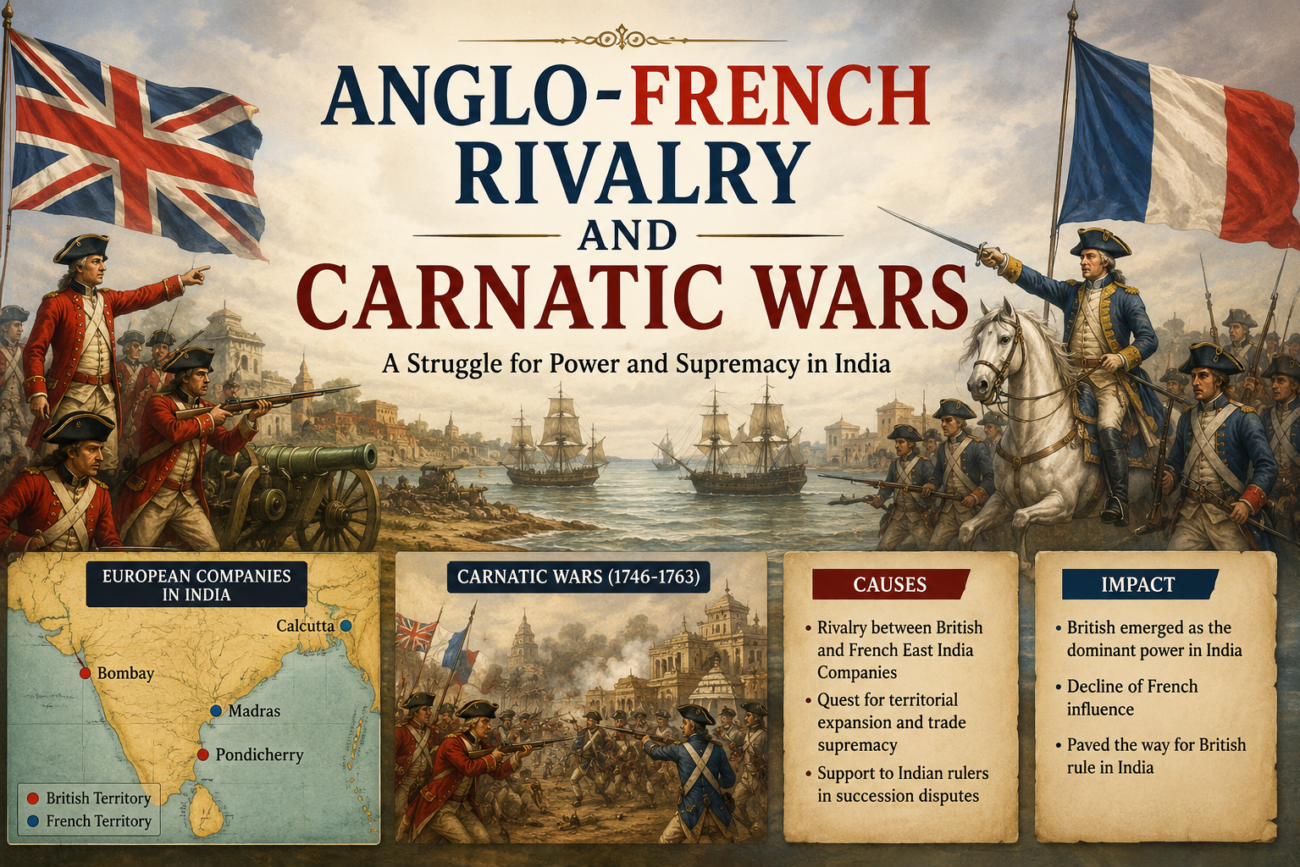
Whose story we will read later. Friends, in the previous chapter we discussed how different European companies came to India to trade. Today we will discuss Rae Bareli between two of them, the English and the French. So let’s start with the introduction. Friends, although the British and the French came to India to trade, they later became involved in Indian politics. This is because both these companies believed in mercantilism, according to which a monopoly in trade was considered necessary to maximize profits. Both powers had commercial monopolies in India, hence both political powers got involved in establishing this. So, it was natural for Rae Bareli to be between the two. Along with this, the reflection of the traditional Anglo-French rivalry already going on in world history is also seen in India. So let us know one by one. In the 1748 background of the three Carnatic regions, the Coromandel region and its surrounding areas were named Karnataka by the Europeans. All the wars between the English and French in India generally took place in this area, hence it was considered an extension of the Austrian War of Succession in Karnataka in 1740. European power reaches India in the form of the First Carnatic War. During the First Carnatic War, the Battle of Sinh Thomas takes place in Madras in 1746, in which Nawab Anwaruddin of Karnataka and French forces face each other. Let us know why this happens. In 1745, the English Navy, under the leadership of Commodore Curtis Bannet, makes some friendship. To take revenge for this, French Governor Dupleix attacks the British Madras factory from Mauritius with a French force and Madras is easily conquered. However, in the meantime, Nawab Anwaruddin Khan of Karnataka tells the French that they cannot fight in his territory like this and immediately orders them to withdraw from Madras. French Governor Dupleix pacifies them by saying that after conquering Madras, he will gift it to the Nawab. After the French conquer Madras, When he did not fulfill his promise to the Nawab, Uddin sent an army of 10,000 soldiers under the command of his son Mahfuz Khan to capture Madras. They then encountered the French army at a place called San Thomas, located on the banks of the River Adyar. The army easily defeated a larger Indian army, as in this battle, 20,030 European and 700 Indian soldiers from the French side defeated a force of 10,000 natives. Apart from this, the importance of French forces in the ongoing Anglo-French conflict in the Deccan also becomes very clear after this war. Friends, the Treaty of Belley ended the First Carnatic War, but their relations did not become friendly due to this. Their rivalry continued and gave rise to the Second Carnatic War. Now let us know about the Second Carnatic War in detail. The background of the 1749 to 1754 period. After the First Carnatic War, the political ambitions of French Governor Dupleix increased. To increase French power and political influence in Southern India, he started interfering in local dynastic disputes there. One of his objectives was to reduce the power of the British. He got the opportunity to do so when a dispute broke out over the boundaries of Hyderabad and Carnatic. Nizam Azam Jang of Hyderabad died on 21 May 1748, and his son Naseeb Jung became the next Nizam of Hyderabad. However, his nephew and Asif Jhan’s grandson, Muzaffar Jung, succeeded him. He challenges and wants the Nizam’s car himself. On the other hand, in Karnataka, Nawab Anwaruddin is being challenged. Dr. Chanda Saheb Dupleix, the foreman of that place and son of Nawab Dost Ali, sees an opportunity in this to further his political plans, hence he decides to support Chanda Saheb for Muzaffar Jung in Deccan and Nawab Shiv of Karnataka. Seeing this, the English side with Nasir Jung and Anwaruddin. Thus begins the story of the Second Carnatic War, which lasted from 1749 to 1754.
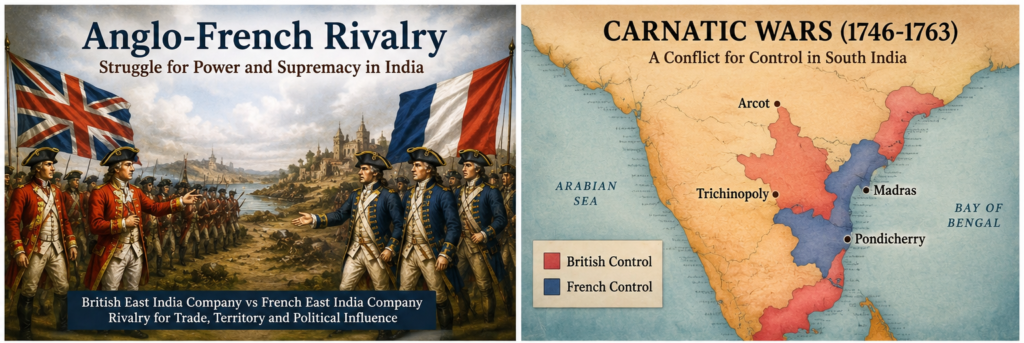
Let us know what events took place during this war. In the course of the world, Dupleix’s plan is successful when Anwaruddin is killed by the combined forces of Muzaffar Jung, Chanda Sahib, and the French during the Battle of Amber near Vellore in 1749. Nasir Jung is also killed in December 1750, and Dupleix is rewarded by being declared governor of the entire Mughal territory south of the River Krishna. Furthermore, some districts of the Northern Government are also given to the French, and at the Nizam’s request, a French army is stationed in Hyderabad to secure the French entrance there. However, shortly after, Muzaffar Jung is killed, and the French appoint Muzaffar’s uncle, Salabat Jung, as the new Nizam. In 1751, Chanda Sahib becomes the Nawab of Carnat. At this time, Dupleix is at the height of his political power, but soon the story takes a turn for the worse. Nawab Anwaruddin’s son, Mohammad Ali Trisno, had taken refuge in Bali Fort. Despite numerous attempts by Chanda Sahib and the French, the district remained unconquered. The British were also not content to sit idle. Robert Clive, unable to provide effective reinforcements to Muhammad Ali at Tiruchirapalli, persuades Governor Sir Robert Clive to launch a counter-move, planning a surprise attack on the Carnatic capital to divert pressure from Tiruchirapalli. According to the plan, Liv captured Arco in August 1751 with a force of only 210 soldiers. Chanda Sahib diverted a force of 4,000 from Tiruchirapalli, but this force failed to capture Arcot. The success at Arcot further boosted British morale, and in 1752, Stringer Lawrence, with a strong English force, recaptured Kitchenerpalli from the French. Meanwhile, Chanda Sahib was murdered by a conspiracy by the King of Tanjore. Muhammad Ali became the Nawab of Carnatic. After the disaster at Tiruchirapalli, Dupleix’s fortunes began to decline. The directors of the French Company, dissatisfied with Dupleix’s political ambitions and the expenditures incurred, recalled him from India to France. It is taken that in 1754, Dupleix was replaced by a new French governor. He began negotiations with the white-clad British and signed the Treaty of Pondicherry in 1755. Let us also understand its implications. The Second Carnatic War made it clear that the European Company did not need the support of the Indian authorities for success; on the contrary, the Indian authorities had become dependent on the Company. Mohammad Ali in Karnataka and Salabat Jung in Hyderabad became clients of the European company. This second round of conflict between the English and the French was also inconclusive. The British candidate Mohammad Ali became the Nawab of Karnataka, but the French were still strong in the Deccan. Their candidate Salabat Jung was the Nizam of Hyderabad. The French company also got some important districts of the Northern Sarkar, which generated an annual revenue of Rs 30 lakh. The French position in South India was somewhat weak, and the British position was somewhat strong. The Anglo-French rivalry in India decided action in the Third Carnatic War. Let us now discuss it in detail. The Third Carnatic War of 1758 and the First Carnatic War of 1763 were also the repercussions of the struggle between the English and the French in Europe. In 1756, the Seven Years’ War started in Europe, and once again England and France faced each other. This was extended to India. The French government appointed General Count Lalli in 1757. India sends a fleet to India, which is to arrive there in 1758 after a 12-month journey. Meanwhile, the British win the Battle of Plassey in Bengal in 1757, gaining resources and capturing it in 1758. Lali’s next move is to capture Madras, but a strong British naval force arrives there, forcing Lali to end the siege. Lali then summons Vasey from Hyderabad. This proves to be a major mistake for the French, as it weakens their land at Gairsain. Meanwhile, the English fleet, under Pocock’s command, defeats the French three times, forcing them to abandon Indian waters. With Vasey in command, the path to victory opens for the British, and there is no doubt about their final victory. On January 20, 1760, the French suffer a crushing defeat at the hands of Sir John Hutchinson at the Battle of Wandiwash in Tamil Nadu. Vasey is taken prisoner. After an eight-month blockade, Vasey is captured. Pondicherry is also conquered by the British.
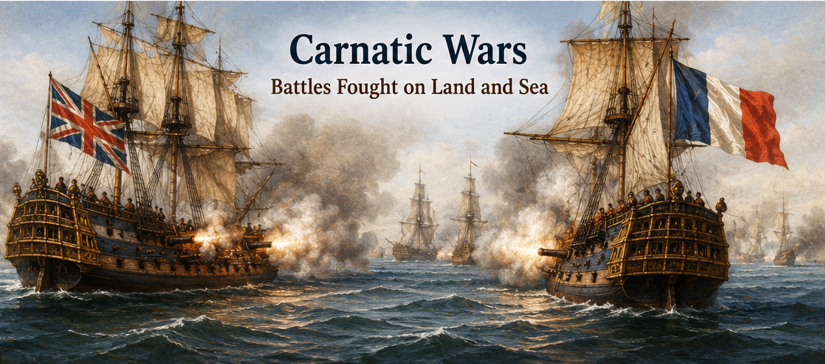
On January 16, 1761, they surrendered Mahe and Jingi to the French. Thus, the curtain finally fell on the drama of the Anglo-French Rivalry in South India. The French position had become irretrievable. Seven years later, the Treaty of Paris was signed in 1763. According to its provisions, the French were returned to Pondicherry and some other settlements, but with the condition that they would never be redeemed. Thus, the political ambitions of the French in India were permanently shattered. Friends, we have learned that in the conflict between the French and English Companies, the English ultimately won, and the French were defeated. We also know some of the reasons behind this. Therefore, there was no lack of enthusiasm and self-confidence among the people working there. The Company was also able to take immediate decisions because it did not require government permission. On the other hand, the French Company was under government control, making it easier for decisions to be made. There were delays in the making of the war. Another reason was the British’s superior navy. With its help, they were able to conquer all the important battles. The British controlled major and important cities in India, such as Kolkata, Bombay, and Madras, while the French held only Pondicherry. Many historians believe that the English could have controlled the entire India starting from Kolkata, but the French could not have done so starting from Pondicherry. Furthermore, the English Company had no shortage of funds. In the midst of the Carnatic Wars, in 1757, the Battle of Plassey took place. Victory further increased the Company’s wealth, but the French continued to face a shortage of funds. Due to political ambition, they ignored commercial interests. Another important reason behind British success was the British’s superior military command. Compared to the long list of leaders like Sir John Lawrence and Robert Clive on the English side, only Dupleix’s name is remembered on the French side. It’s a relief friends, these were some of the reasons due to which the English were able to defeat the French and establish their dominance in India.
Conclusion: After victory in the Third Carnatic War, the English East India Company had no European rivals in India and they focused on becoming a dominant political power in India. How the East India Company gradually established an empire.
