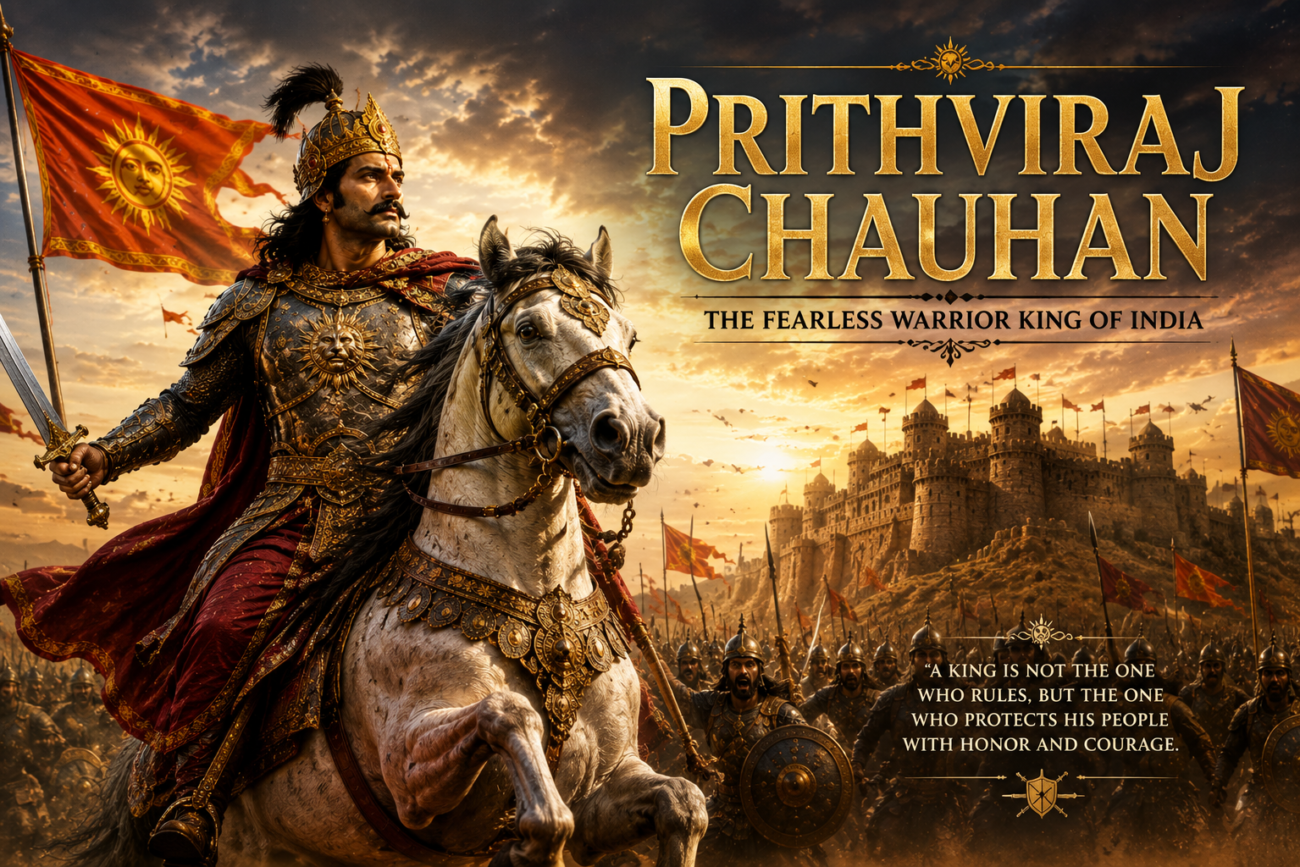

India’s history is replete with countless tales of valor and heroism. Yet, among these stories, certain names have not faded into the dust of time but continue to resonate to this day. One such name is that of Emperor Prithviraj Chauhan. Establishing his capital in Ajmer and Delhi, this young emperor commanded such authority in Indian politics that the mere mention of his name struck terror into the hearts of his enemies. Prithviraj was not merely a master of the sword and spear; he was also deeply learned and skilled in various disciplines. He possessed knowledge of multiple languages and an understanding of mathematics and philosophy. His most remarkable skill, however, was the art of Shabd-bhedi baan the ability to strike a target guided solely by sound, without actually seeing it. Tales of his valor were so renowned that princesses from neighboring kingdoms were captivated by his legend. Yet, history is not composed solely of heroic sagas; it is also a theater of politics, rivalries, and treachery elements that were all present in Prithviraj’s story. On one hand, he was locked in a feud with King Jaichand of Kannauj a rivalry intertwined with the immortal love story involving Jaichand’s daughter, Sanyogita. On the other, a new threat was emerging from the west in the form of Muhammad Ghori, who sought not merely to plunder but to establish permanent rule over India. In 1191, history took a decisive turn when the armies of Prithviraj Chauhan and Muhammad Ghori clashed on the battlefield of Tarain. In this conflict, Prithviraj’s strategic brilliance and might dealt a crushing defeat to Ghori. It is said that Prithviraj Chauhan defeated Muhammad Ghori sixteen or seventeen times, sparing his life and letting him go on each occasion. Ultimately, however, this very magnanimity proved disastrous for both him and India. Let us explore the full story of Emperor Prithviraj Chauhan, whose valor still resonates across the soil of India. The roots of the Chauhan dynasty were linked to Sambhar and Amer, near Jaipur. King Ajay Raj of this lineage laid the foundation of the city of Ajmer, which later became the seat of Chauhan power. The dynasty was established in the 6th century by Vasudeva Chauhan. Later, in the 11th century, a mighty king named Someshwar Chauhan emerged from this lineage. Someshwar fought numerous battles during his lifetime and expanded his empire. It is believed that when the Rathore army attacked King Anangpal Tomar of Delhi, King Someshwar Chauhan of Ajmer came to his aid. With his support, Anangpal Tomar won the battle, leading to a deep friendship between the two. This friendship eventually blossomed into a familial bond when King Anangpal married his daughter, Karpuri Devi, to Someshwar Chauhan. Anangpal Tomar’s other daughter, Roop Sundari, was married to King Vijaypal of Kannauj; they later had a son named Jaichand. In 1166, a son was born to Someshwar Chauhan and Karpuri Devi. His birth was considered an auspicious sign for the Chauhan dynasty, and astrologers predicted that he would grow up to be a great ruler and govern a vast expanse of the earth. Keeping this prophecy in mind, the child was named Prithviraj. Since two kings named Prithviraj had already existed in the lineage prior to his birth, he was technically Prithviraj III. Prithviraj’s childhood was not that of an ordinary prince; just as the quality of a sapling is evident early on, his extraordinary talent was visible from his childhood. Prithviraj Chauhan possessed deep knowledge of numerous languages and was proficient in subjects such as history, mathematics, medicine, military science, and philosophy. His most remarkable skill was the art of Shabd-bhedi shooting an arrow guided solely by sound. This technique allowed him to strike a target with his eyes closed, relying entirely on auditory cues. He possessed such mastery over archery that even the greatest warriors could not match him; furthermore, he was equally adept at wielding the sword and the spear. An incident from his youth serves as a testament to his immense strength and fearlessness. It is said that once, while hunting in the forest with his friends, he was suddenly attacked by a ferocious lion. Terrified by the sight of the beast, his companions retreated, but the young Prithviraj stood his ground fearlessly, even though he was unarmed. As the lion lunged at him, Prithviraj seized its neck with lightning speed and, using all his might, tore its jaws apart. The lion could not withstand his immense strength; its jaw was shattered, and the beast collapsed right there. This incident was not merely about a hunt; it was proof that Prithviraj Chauhan was fearless, powerful, and astute from childhood. However, a test of fate awaited him soon. His father passed away when he was only eleven years old. Suddenly, the responsibility of the entire kingdom fell upon young Prithviraj’s shoulders, and as Someshwar Chauhan’s successor, he had to ascend the throne of Ajmer. It was a precarious time; taking advantage of his youth, his own feudatories and chieftains began to rebel and attempted to seize parts of the kingdom. In this hour of crisis, his mother, Queen Karpuri Devi, took charge of the administration. Serving as regent, she brought stability to the kingdom with the help of trusted ministers like Kadambvas. However, according to the Hammira Mahakavya, it is believed that Prithviraj Chauhan’s father, Someshwar Chauhan, did not die at that time; instead, he voluntarily handed over the throne to his son and retired to the forest to lead an ascetic life. Subsequently, under the guidance of his mother, Queen Karpuri Devi, young Prithviraj learned the intricacies of governance. He soon became so adept at administration that the courtiers and the people of the kingdom could not stop singing his praises. Yet, a kingdom could not be ruled from the safety of his mother’s protection. Thus, at an age when children are usually occupied with play, he shouldered the burden of the entire state. In 1180, at the age ofjust fourteen, he assumed full power and began ruling as an independent sovereign. This marked the beginning of the journey of a heroic warrior whose name would eventually echo from the throne of Delhi to the battlefields of Tarain. Upon assuming power, it became evident to Prithviraj that his greatest challenge was not external invaders, but his own people. His own kinsmen were taking advantage of his youth to rebel and attempt to seize parts of the kingdom. This episode illustrates just how weak and unstable India’s feudal system was during the 12th century; in the absence of a strong central ruler, the loyalty of local chieftains would shift from the state to their own personal interests. About three years after his coronation, the young Prithviraj Chauhan stepped out from under the guardianship of his mother, Queen Karpuri Devi, and began to establish himself as a powerful emperor. His first and most crucial task was to crush the rebellion led by Nagarjun. Nagarjun was the son of Vigraharaja IV, Prithviraj’s uncle. Taking advantage of Prithviraj’s youth, he staked a claim to the throne and seized the fort at Gunpura a place known today as Gurugram. This was not merely a rebellion but a direct power struggle within the Chauhan dynasty. Prithviraj Chauhan besieged Gunpura with a massive army comprising infantry, cavalry, camel corps, and war elephants; he defeated Nagarjun in battle and reclaimed both the fort and the surrounding territory. According to the epic Prithviraja Vijaya, he captured many of Nagarjun’s soldiers, beheaded them, and displayed their heads on the walls of the Ajmer fort. Although Nagarjun managed to escape, this victory served as a stern warning to anyone challenging Prithviraj’s authority: challenging the king’s rule regardless of his youth would be suicidal. Following this success, Prithviraj not only secured his kingdom but also began expanding it into a vast empire. Subsequently, in 1182, Prithviraj Chauhan quelled the rebellion of the Bhadanakas, whose territory spanned from Bhiwani and Rewari in present-day Haryana to Alwar in Rajasthan. This victory over the Bhadanakas was particularly significant because their territory lay on the route to Delhi. Delhi had been conquered by Prithviraj’s uncle, Vigraharaja IV, between 1150 and 1164; thus, by the time Prithviraj ascended the throne, Delhi was already part of his empire. As Delhi was a major center for trade and strategy, Prithviraj designated it as his second capital after this victory, further consolidating his position in North India. He also constructed the Qila Rai Pithora in Delhi, which became a pivotal site for this capital city. Following these initial victories, Prithviraj Chauhan’s army launched military campaigns in multiple directions. His empire expanded rapidly, soon encompassing large parts of Rajasthan, western Uttar Pradesh, northern Madhya Pradesh, and southern Punjab. This vast empire spread his renown far and wide, establishing him as the most powerful Indian ruler of his time. The most famous and bloody conflict of his military campaigns was fought at Mahoba in 1182 against the Chandela king, Paramardi Deva. The conflict arose after Chandela soldiers attacked some of Prithviraj’s wounded and exhausted troops, who had camped in their territory without permission. Enraged by this incident, Prithviraj launched an attack on Mahoba with a massive army. This battle became immortal in Indian folklore and history for the amazing bravery of two great Chandela generals, Alha and Udal. Both the brothers gave a tough fight to the Chauhan army to protect their motherland and displayed immense courage. It is said that Udal was killed in this war. Angered by this, Ala attacked Prithviraj’s army with full force. Whoever came in front of the niche at that time was killed. But ultimately the Chandelas were defeated in this war. Prithviraj conquered Mahoba and Paramardi Dev had to flee. This was a major victory for the expansion of Prithviraj’s empire. However, this victory was not achieved easily. Prithviraj also suffered heavy losses in this war and many brave soldiers of his army were killed in it. During this time, Prithviraj’s political enmity with another powerful dynasty came to the fore. This enmity was with the Garhwal king Jaichand of Kannauj. Both the kings wanted to spread their empire far and wide. That’s why there was rivalry between them. However, it is also believed that Jaichand considered his right to the throne of Delhi because Delhi was once ruled by Jaichand’s maternal grandfather Anangpal Tomar, which was snatched away by the Chauhans. Because of this, there was enmity between the two dynasties regarding power and supremacy for many years. Jaichand even helped the Chandela king against Prithviraj Chauhan in the battle of Mahoba. According to Prithviraj Raso, this conflict became more personal when Jaichand’s daughter Sanyogita entered the story. It is said that Sanyogita fell in love with Prithviraj after hearing stories of his bravery and valor and had made up her mind that she would marry only him. When this news reached Jaichand, he became furious. He had an old enmity with Prithviraj and could never accept this relationship. Jaichand saw this love of his daughter as an insult to himself and his kingdom. To avenge this insult, Jaichand made a move and organized a grand swayamvar. Swayamvar was a tradition of ancient India in which many suitors gathered in a gathering for a suitable princess for marriage and the princess chose one of them as per her choice. Jaichand invited all the major kings and princes of India but deliberately did not invite his biggest enemy Prithviraj. Not only this, to further insult Prithviraj, Jaichand made a statue of him and placed it at the place of a gatekeeper at the main gate of the court. Somehow Prithviraj Chauhan gets wind of this. When the day of Swayamvar came, all the kings sat at their places but Sanyogita did not choose anyone. Ignoring all the kings, Sanyogita went straight to the idol of Prithviraj and put the garland around the neck of that idol. At that very moment, Prithviraj, who was secretly present there with some of his soldiers, came forward and in front of everyone, made Sanyogita sit on his horse and left Kannauj towards Delhi. On the way, Jayachand’s army pursued them, but Prithviraj succeeded in safely taking Samyogita to Delhi and marrying her. However, this love story between Samyogita and Prithviraj appears only in the Prithviraj Raso, and many historians consider the event to be fictional. Yet, it is certain that the relationship between Prithviraj and Jayachand was never cordial. The conflict ran so deep that even when the threat of foreign invaders loomed over India, neither king was willing to support the other. Furthermore, after winning the Battle of Mahoba, Prithviraj had turned a powerful neighbor into a permanent enemy. Consequently, this mutual animosity prevented the formation of a powerful alliance capable of stopping foreign forces from setting foot on Indian soil; this very rivalry would go on to alter the course of Indian history forever. While Emperor Prithviraj Chauhan was expanding his empire, a new and formidable enemy was emerging in the west. This adversary was the ambitious and ruthless invader Mu’izz al-Din Muhammad ibn Sam, known in India as Muhammad Ghori. Ghori was a ruler of the Ghurid dynasty, with an empire spanning present-day Afghanistan. His objective was not merely to plunder India but to establish a permanent empire there. Driven by this ambition, Ghori launched a major attack on the kingdom of the Chalukya ruler Bhima II of Gujarat in 1178. However, he encountered fierce resistance led by Queen Naikidevi, the mother of Bhima II. She defeated Ghori’s army so decisively that he was forced to flee the battlefield to save his life. This was a major defeat for Ghori, compelling him to revise his strategy. He realized that entering India via the southern route was extremely difficult; consequently, he changed his approach and focused on the north. His strategy paid off; he soon captured Sindh, Peshawar, and Sialkot, and in 1186, he defeated Khusrau Shah Malik the ruler of Lahore to seize that territory as well. Ghori was unstoppable after these successive victories; his next target was the Chauhan Empire. In 1191, he launched a surprise attack to capture the fort of Tabar-e-Hind (modern-day Bhatinda) and placed it under the command of his general, Zia-ud-Din, along with 1,200 horsemen. This move set two powerful empires on a collision course. Ghori’s capture of Bhatinda posed a direct challenge to Prithviraj one he could not ignore. In response, Prithviraj assembled a massive army and marched against Ghori. In 1191, the armies of Prithviraj Chauhan and Muhammad Ghori confronted each other on the plains of Tarain in Haryana. Each army possessed distinct strengths: Ghori’s forces included mounted archers renowned for their speed, whereas Prithviraj Chauhan’s army consisted primarily of infantry. However, the latter commanded the might of war elephants and excelled in close-quarters combat. At the start of the battle, Muhammad Ghori’s army leveraged its greatest asset: mounted archers who unleashed a barrage of arrows at Prithviraj’s infantry from a distance. Their tactic involved striking and rapidly retreating to avoid direct engagement. In contrast, the Rajput warriors believed in face-to-face combat, where they could confront the enemy with swords and spears. Prithviraj Chauhan’s army swiftly closedthe distance, launching a powerful offensive that began to overwhelm the enemy. This sudden assault by Prithviraj caught Ghori’s forces off guard. Furthermore, the massive elephants of Prithviraj Chauhan’s army wreaked havoc on the enemy forces, shattering their ranks and causing a stampede within the opposing camp. The fierce frontal assault by the Rajput soldiers, combined with the might of the elephants, completely demoralized Ghori’s troops, causing them to flee the battlefield. Amidst the battle, Muhammad Ghori himself entered the fray, attempting to rally his men. He came face to face with Govind Rai, the commander of the Rajput army and the Governor of Delhi. Ghori attacked him with a spear, but Govind Rai parried the blow and launched a counter-attack, wounding Ghori. Ghori collapsed, nearly unconscious. Somehow, one of his soldiers managed to carry him off the battlefield, saving his life. Seeing their commander retreat completely shattered the morale of Ghori’s army, and the remaining soldiers fled the field. Prithviraj’s forces recaptured the Tabar-e-Hind fort. However, following this victory, Prithviraj committed a strategic blunder a mistake for which both he and all of India would eventually pay a heavy price. He did not pursue the fleeing enemy and spared Muhammad Ghori’s life. It is believed that Emperor Prithviraj Chauhan defeated Muhammad Ghori not just once, but some 16 or 17 times, letting him go on every occasion. This reflected the Rajput code of war ethics and their magnanimity; they would not strike a fleeing enemy. Modern historians term this the “Prithviraj Syndrome” a tendency where showing mercy gives the enemy a chance to regain their strength. Yet, this very generosity would prove to be suicidal. Humiliated by his repeated defeats at the hands of Prithviraj Chauhan, Muhammad Ghori returned to Ghazni. There, he publicly shamed the captains and commanders of his forces who had displayed cowardice during the battle. Ghori vowed to abstain from his life of indulgence until he had avenged his defeat. With this resolve, he reorganized his army, placing a renewed emphasis on discipline, mobility, and deception. After thorough preparation, he recaptured Bathinda in 1192 a stronghold the Chauhans had reclaimed only a month earlier. This news enraged Prithviraj Chauhan; he mobilized his army and marched once more toward Tarain to confront Ghori. However, his forces were weaker this time, as many of his generals had been occupied with various other campaigns over the preceding months. Once again, the two armies stood face-to-face on the battlefield of Tarain. Prithviraj sent a message stating that if Ghori returned without a fight, he would be allowed to leave; otherwise, he would be utterly destroyed. Ghori laid a trap; feigning acceptance of the terms, he claimed he needed to consult his brother before deciding. In reality, he was using this time to ready his army and monitor the Chauhan forces. This ruse misled Prithviraj, causing his army to lower its guard and lose its vigilance a fatal error. Ghori knew the Rajputs were formidable in direct combat, so he divided his troops into small units with orders to launch ranged attacks and retreat immediately if the Rajputs counter-attacked. The tactic worked. As Ghori’s forces launched these distant attacks, Prithviraj Chauhan’s army gave chase, falling right into the trap. The relentless pursuit exhausted the Rajput elephants, horses, and infantry, denying them any rest overnight. The next morning, while the Rajput army was disorganized and occupied with routine activities, Ghori’s forces launched a sudden, decisive attack. Unable to withstand this combination of treachery and strategic maneuvering, the Rajput army collapsed. Emperor Prithviraj Chauhan was defeated and taken prisoner, marking the end of the Second Battle of Tarain with a decisive victory for Ghori. This defeat stemmed not from a lack of valor on Prithviraj Chauhan’s part, but from strategic lapses and an underestimation of the enemy; his code of conduct which spared even a fleeing foe proved ineffective against a ruthless invader like Ghori. Its sole objective was to achieve victory by any means necessary. This defeat paved the way for the establishment of Muslim rule in India and altered the course of Indian history forever. It is widely believed that King Jaichand of Kannauj secretly sided with Muhammad Ghori in this battle; consequently, the name ‘Jaichand’ became synonymous with ‘traitor’ in later folklore. However, many historians dismiss this story as false, arguing that while Jaichand may not have supported Prithviraj, he did not side with Ghori either. Nevertheless, Muhammad Ghori eventually defeated and killed Jaichand as well. The manner of Emperor Prithviraj Chauhan’s death following the Second Battle of Tarain remains a subject of debate among historians, with various contradictory views existing on the matter. Some historical sources suggest that Prithviraj was martyred on the battlefield itself, while other accounts claim he was taken prisoner to Ajmer. There, Muhammad Ghori attempted to reinstate him as a vassal ruler but later had him executed on charges of conspiracy. Additionally, the most popular account of Prithviraj’s death appears in the epic Prithviraj Raso. According to this narrative, after the defeat at Tarain, Ghori took Prithviraj prisoner to Ghazni and subjected him to severe torture. When Emperor Prithviraj Chauhan refused to lower his gaze before Ghori, the latter ordered that his eyes be gouged out. The order was carried out; the unarmed Prithviraj, bound in shackles and chains, was blinded by having red-hot iron rods thrust into his eyes. Emperor Prithviraj was willing to sacrifice his eyes but refused to bow his head in submission. During this time, Prithviraj’s court poet, Chandbardai, also managed to reach Ghazni. He discovered that Ghori was planning to humiliate and execute Prithviraj in full view of the entire city. Chandbardai devised a plan and told Ghori, “Sultan, the man you are about to execute is no ordinary king; he is Emperor Prithviraj Chauhan, who has humbled you on the battlefield dozens of times.” Mocking Prithviraj Chauhan, Ghori remarked that the blind man was now of no use. Chandbardai countered, “You do not realize our Emperor is a master of the art of Shabd-bhedi (shooting an arrow guided solely by sound). He can strike a target merely by hearing the sound.” Ghori mocked Prithviraj Chauhan again, declaring that if that were true, the entire city would witness the spectacle. Subsequently, an assembly was organized, drawing a massive crowd. Prithviraj’s shackles were removed, and a bow and arrow were placed in his hands. Ghori laid down a condition for Chandbardai: if Prithviraj failed to shoot the arrow by sound alone, he too would be beheaded. Chandbardai smiled and replied that such a situation would not arise. The feat began, and Chandbardai recited a couplet: “Four baans, twenty-four gaj, and eight anguls away—there sits the Sultan; do not miss, Chauhan.” This couplet gave Prithviraj an exact sense of Ghori’s position on the high throne. He aimed his bow, and the arrow pierced straight into Ghori’s chest, killing him instantly. As Ghori’s soldiers rushed to kill Chandbardai and Prithviraj, the two men stabbed each other to death, ensuring that their own names and not those of their enemies would be associated with their final moments. This story has been recounted for generations as a symbol of bravery and revenge, though it is not considered historically accurate. Significant questions have been raised regarding the credibility of the Prithviraj Raso; it is widely believed to have been written in the 16th century roughly 400 years after Prithviraj Chauhan’s era. Furthermore, historical evidence indicates that Muhammad Ghori was assassinated in 1206, whereas Prithviraj had already died in 1192. Consequently, many historians regard the story of Prithviraj Chauhan’s end as fictional. Following Prithviraj’s death, his empire comprising Ajmer, Delhi, and parts of Rajasthan fell under the control of Ghori’s army. Delhi came under the command of Qutb-ud-din Aibak, a general of Muhammad Ghori, after whom the Qutb Minar in Delhi is named. Additionally, in Ajmer, Ghori installed Prithviraj’s minor son, Govindaraja IV, as a puppet ruler who paid tribute to him. Prithviraj’s brother, Hariraja, refused to accept this arrangement; he ousted Govindaraja IV and seized control of Ajmer. This rebellion led to regional instability, an opportunity seized by Qutb-ud-din Aibak, who attacked Ajmer and defeated Hariraja. This marked the final blow, transforming Ajmer once a symbol of Rajput pride into part of the Delhi Sultanate. Other territories of the empire, such as Mahoba, were either divided among local dynasties or conquered by Muhammad Ghori. Thus, the death of Prithviraj Chauhan paved the way for intensified Muslim invasions and the establishment of Muslim rule in India a reign that lasted for centuries yet the tales of Emperor Prithviraj Chauhan’s valor, courage, and heroism became immortal in history. His story inspired future generations and established him as a symbol of national pride. His legacy reminds us that while a battle may be lost, the story of valor, honor, and courage never dies.
Prithviraj Chauhan: The Fearless Warrior King of India