

Indus Valley Civilization Part 2
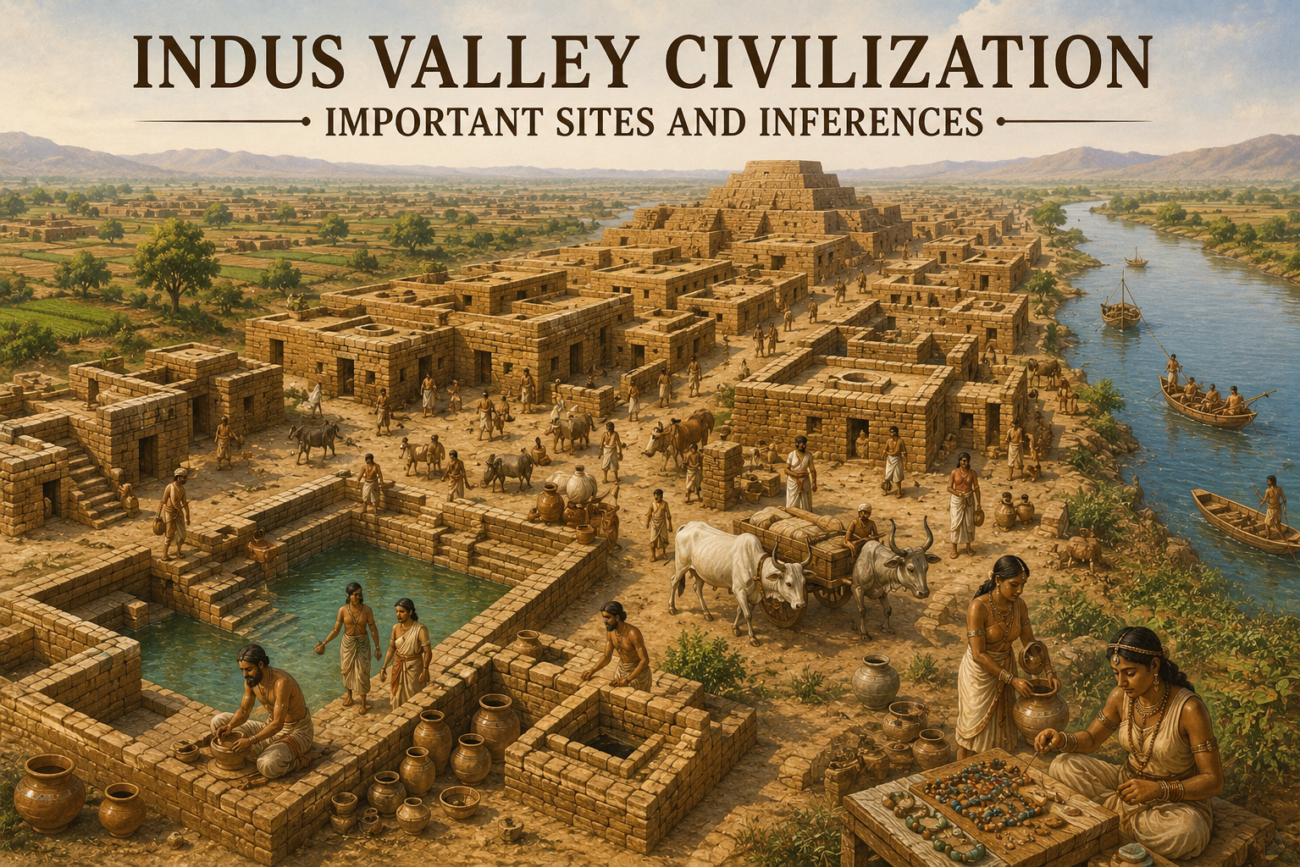
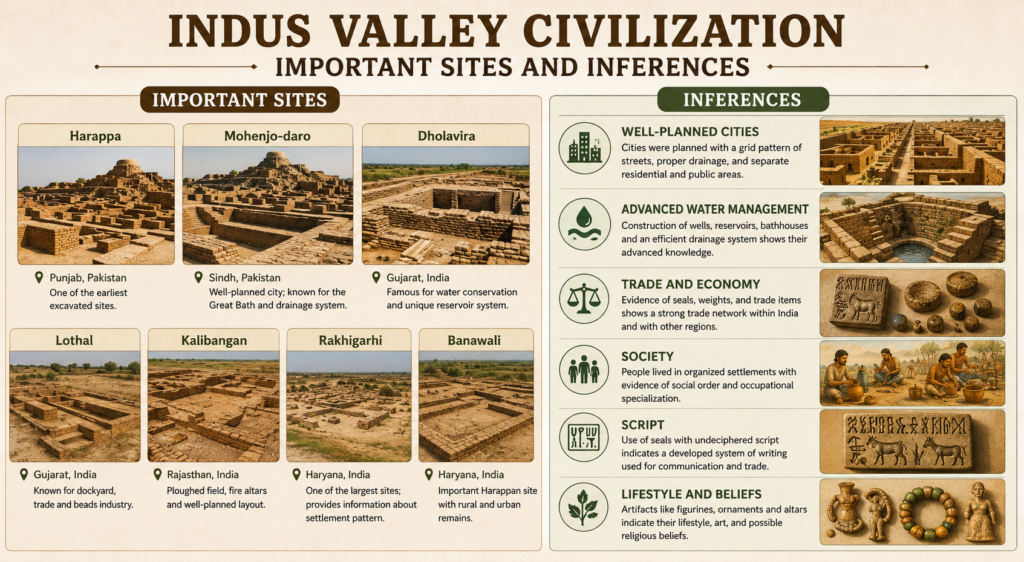
Important Sites and Influences Friends, we’re talking about the Indus Valley Civilization, the first urban civilization in India’s history. In the previous video, we examined why the Indus Valley Civilization is such an important part of our history and what major excavations have taken place there. We also tried to understand the evidence of the Indus Valley’s important architectural and cultural elements. In this second part, we’re going to discuss some of its important sites and learn what the evidence found here tells us about the Indus Valley’s society, politics, and economy. Furthermore, there are many controversies regarding the Indus Valley’s decline, which we’ll explore in this video. We’ll talk about some of the major IBC sites. Some important sites: Harappa, friends. Harappa is located on the banks of the Ravi in Pakistan’s Punjab province. Being near the Ravi, it had access to trade networks, aquatic food and drinking water, and cultivation. Harappa It is also considered to be the meeting point of the trade route coming from the East. The major excavations here include granaries with Greek platform workers’ rooms, bronze smelting at cetera, about which we talked in the previous video. Harappa is the only site where evidence of coffin barriers has been found. The next site is Mohenjodaro, whose English translation is Mound of the Dead, and it is located on the banks of the Indus in Larkana, Punjab province of Pakistan. Here, the Great Bath, the Great Granary, Bronze Dancing Girl Cell of Pashupati, Statue of the De Beer Dead Mother, the maximum number of unicorn cells and pieces of forest cotton have been found.
Mohenjo-daro is also a UNESCO World Heritage Site. The next site is Dholavira, located in the Rann of Kutch in Gujarat. Recently, the Indian government has also proposed its inclusion in the UNESCO World Heritage Sites. It is famous for its large reserves and elaborate water harvesting system. Let us now understand the theories related to the Harappan political system. Friends, this is a very interesting question: how the Indus Valley Civilization continued to flourish as a uniform civilization despite the absence of such a complete communication system and spread across such a vast area. According to research quality, some historians believe that the architectural magnificence and uniformly beautiful sculptures of the Indus Valley Civilization reflect the power of the ruling class. This shows that they had the ability to mobilize labor and taxes for massive structures and brilliant town planning. The political system here was probably a centralized system, which is why the IBC color was a uniform color. Apart from this, in The stone tablets found in the tombs were probably the seat of power and the treasury of the Great Grandery State of Mohenjo Daro, where collectorate tributes were kept as taxes. The political system was at its peak in the mature Harappans and was also the most well-developed. Many cities were well fortified and the entire area was populated. However, there is no evidence of an organized military here, but a standing army was probably posted, as descriptions of soldiers are found in many stones.
The absence of archaeological evidence of any temple here indicates that perhaps there was no rule of priests here and the polity was secular. For the rulers here, trade and commerce were more important than conquest and perhaps these rulers were lazy merchants. But this explanation of polity is not conclusive because according to other theories, perhaps there was not a single centralized state here, rather there were different rulers in Harappan cities who represented each urban center, perhaps like the medieval Italian city states like Florence, Geneva, Milan etc. Well, for any political system, it is necessary that the economy there should also be based on strong foundations. Therefore, now we move towards the economy here. Economy Agriculture Friends, there was economic activity in agriculture in the Indus Valley, the major reason for which was the fertility of the Indus Valley. This fertility was due to the annual overflow of the Indus, the evidence of which is available on the Board of BRICS. There are walls which were used for flood control. Crops in the Indus Valley include wheat, rai, sesame, mustard and peas but there is also evidence of rice in Lothal and Rangpur. An interesting thing about the IBC is that these people were probably the first to produce cotton. We have found evidence of woven cotton from Mohenjo Daro and spindle world in almost every house shows this Weaving was a common practice. There is no evidence of any metal pots or casks here, but the finds at Rakhigarhi and Kalibangan indicate that the work was probably done with wooden blades and stone cutting tools. Apart from the Shore Tagari for irrigation, there is no major canal evidence, but there were definitely small water tanks. The fields at Kalibangan also show that two crops were grown simultaneously there. Apart from this, animal domestication was also common, which included ox, buffalo, goat, sheep, big and small animals. The people here were also aware of dogs, cats, elephants, rhinos, donkeys and camels. They were also used in blowing and trading. The most surprising thing is that the Harappans were not aware of horses, as no conclusive evidence has been found on this. There is a terracotta horse-like creature at Mohenjo Daro and skeletons of horse-like animals at Kotda, but it cannot be claimed that they were horses. However, controversy aside. It is clear that unlike future civilizations, the Harappan civilization was not horse-centric at all.
Apart from agriculture, trade and commerce were also prevalent in Harappan economics. So, let us now examine the extent of Harappan trade and commerce. The seals found in granaries, uniform script, weights and measures, and the importance of trade are evident here. Lothal was an important port in the Gulf of Khambhat. Trade was largely based on water systems, meaning there was no Shore Tu Gai Lopez Lesuli. Lothal was famous for the Carthaginian trade, Khetri mines for copper imports, Afghanistan for silver imports, and South India for gold trade. Let us now understand what archaeological evidence tells us about society and religion in Harappa. In terms of society, there was probably a well-established social hierarchy in the society here, which is reflected in the existence of the upper and lower tones. Social hierarchy is also evident in the differences in the residential structures here, some small and some large. Good quality sculptures and sculptures are also found here. Rare objects of valuable materials were also found mostly in larger settlements, which indicates a regional divide. However, the major parts of the instances are found only in Harappa and Mohenjodaro, but not in sites like Kalibangan. The fashion sense of the Harappans was also highly emphasized, which is visible in the white spread bead and ornaments here. These include necklaces, phillips, omelets, fingerings, earrings, which were made of precious metals, gemstones, bronze and bed clay. This fashion sense was flourishing in the bead industries and Lothal. This fashion sense is also visible in the different types of close hairstyles and braids here.
There is also evidence of lipstick, cosmetics, and face paint, which are fashionable items even in modern times. Regarding religion, no other religious structures were found here except the Great Bath, but inferences can be drawn from the remaining evidence regarding the religious practices of the people here. Numerous female terracotta figurines and embryonic woman rape stations probably depict gods of the Earth. The Harappans likely viewed Earth as a fertility deity and worshipped it. Furthermore, Pashupati Mahadev was also likely a deity, depicted in a yogic posture with three horned heads in a cell. There is also evidence of stone palace worship. The Harappans likely also practiced tree worship, as we find a depiction of a daughter in the branches of a peepal tree. The most important evidence of animal worship is the one-horned unicorn cell. Representations of several other animals in cells also indicate animal worship. The discovery of an ambulance here suggests that they may have also believed in evil forces. After all this, the question arises: friends, if we talk about the language of the Harappan civilization, it was a protohistoric society, which means written evidence has been found here, but the script has not been decoded. The Harappans invented the art of writing, but it was probably developed internally. The Harappan script is loosely pictographic, which means it has diagrammatic symbols instead of alphabets. Their writing style is called boustrophedon, which was written right to left and then left to right. Burial practices are also given great importance in Asian civilizations, so now we will learn about Harappan burial practices in detail. Burial practices in Mohenjo Daro are of three types: complete burials, fractional burials, and post-cremation burials. In fractional burials, dead bodies were first left for wild animals and birds, and later the dead bodies were buried. The most common burial practice was extended burial of humans, in which the head was generally towards the north. Bodies wrapped in wooden coffers and reddish cloth have been found in Harappa. Evidence of pot burials from Suit Kotda Evidence of double burials has been found at Lothal where male and female bodies were buried together
In this particular case, the female skeleton bears a head injury, leading to claims that a practice similar to widow sacrifice existed here. However, no such injury was found in the double barrier discovered at Rakhigarhi in 2019. The absence of such a double barrier system indicates that the widow sacrifice theory is likely weak. Furthermore, the pottery and other artifacts in the burials, such as bangles and beads, indicate a belief in the afterlife. Qualitative differences in the artifacts in the burials support theories of social hierarchy. This was the story of Harappa’s society, color politics, and economics. However, despite such a magnificent civilization, historians say it mysteriously ended. Let’s consider the Harappan decline as the decline of theories. Friends, there is considerable controversy surrounding the Harappan decline, and no theory provides 100% certainty. Historians believe that this process began around 1700 AD. According to one theory, Harappa was destroyed by invaders, this is called the Aryan Invasion or Migration Theory. Some evidence suggests that people started hiding their valuable items in their homes, perhaps due to fear of an invasion.
In 1920, the skeletons of 39 men, women, and children were found at Mohenjo Daro, and it was predicted that they might have been killed in an outside invasion. However, it was later discovered that only two skeletons bore marks of a saur-like attack, and those were from an old village. Furthermore, there is no direct evidence of any battle. It is possible that these 39 people at Mohenjo Daro died from disease. Debates over the Aryan theory continue today, especially in biology and genetic studies. Two studies published in the journals Cell and Science in 2019 reignited the debate over the Aryan invasion theory. The studies published in these journals were interpreted differently in the media. Some argued that these studies disproved the Aryan migration, while others argued that these studies were misrepresented. According to a report published in Scroll, most scholars involved in these studies outright rejected the Aryan theory. The next theory holds these one mental factor responsible for the Harappan decline. It is said that around 1700 AD, both Yamuna and Sutlej started flowing in new courses, blocking their old courses, and Hakra Ghaggar also dried up in this area. Due to this, the water supply here decreased. Apart from this, rainfall also decreased in this area. The reduction in soil fertility reduced soil production and urban people died from starvation. Nishant Malik, a mathematician and scientist from the Rochester Institute of Technology, claimed in the journal Kios (Interdisciplinary Journal of Nonlinear Science) that climate change was the cause of the Harappan decline. This prediction was based on a mathematical modeling. Apart from this, according to geophysicists Mani Ka Prasad and Amavas Noor of Stanford University, earthquake was the major region of the IBC decline. Although this region is considered tectonically inactive, but the earthquake that occurred in 2001 After the activities, these researchers also analyzed the historical and current size data of the city and said that the history of earthquakes here is quite old.
There is archaeological evidence of the existence of the IVC at Dhola Vir around 2200 AD and Kalibangan between 2900 and 2700 BC. Political crises led to the collapse of trade networks, leading to the decline of the IVC’s urban centers. Whatever the reason, it is a fact that from 1900 AD onward, Harappan cities began to decline, and people shifted from the Indus Valley to other areas, where the post-Harappan culture emerged. This was significantly backward from Harappa. Its important colors include the Malwa culture, the Harappan culture, and the Jorhat culture, which was primarily a copper-dominated society, and was quite different from Harappa. After the IVC, such prominent civilizational growth was seen 1500 years later in the Mahajanapadas and Magadha, but until then, Indian society remained village-dominated. So, friends, this was the story of the Indus Valley Civilization, whose achievements inspire us even today.
