

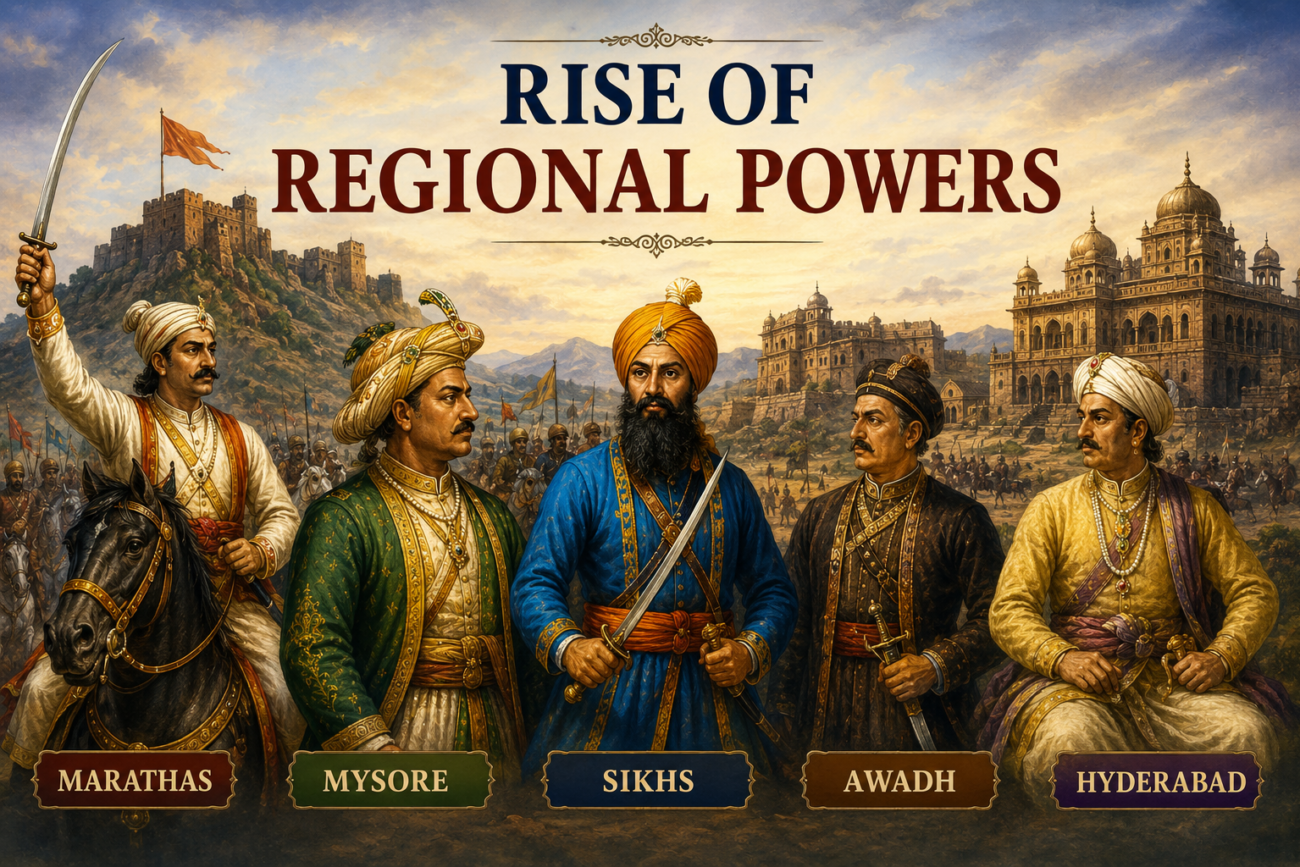
The Rise of Regional Powers After the Mughals. Friends, in the previous video, we saw how the decline of the Mughal Empire began during the reign of Aurangzeb. Due to these competing successes, this empire was completely eliminated. Local and regional political forces emerged and began to assert themselves. This means that the late 17th century saw major changes in politics. During the 18th century, several independent and semi-independent powers emerged, such as Bengal, Awadh, Hyderabad, Mysore, and the Maratha Kingdoms. These were the powers that became political after the decline of the Mughal Empire. It was against these powers that the British established their supremacy in India. Friends, today we will discuss these regional powers that rose after the Mughal Empire by classifying them and seeing what the features of these states were. Classification of Status: The regional powers that emerged after the decline of the Mughal Empire can be divided into three categories.
In 1720, he also held the Viceroyalty of the Deccan. Between 1720 and 1722, he defeated all 22 royal claimants. Between 1722 and 1724, he served as the Wazir of the Mughal Emperor. Frustrated with Emperor Muhammad Shah’s actions in these capacities, he decided to return to the Deccan, where he could maintain his supremacy. It was there that he laid the foundation of the Hyderabad State. He never openly declared his independence, but in practice, he ruled as an independent ruler. He adopted a tolerant policy towards Hindus. For example, he appointed a Hindu, Puran Chand, as his Diwan. He established an orderly administration in the Deccan by implementing the Jagirdar system on the Mughal pattern and consolidated his power. He also kept the powerful Marathas out of his dominion. After Nizam-ul-Mulk’s death in 1748, Hyderabad was again disintegrated. Talking about Karnataka, this region was a Mughal suzerainty and came under the authority of the Nizam of Hyderabad. The Karnataka region was the peninsular region between the Eastern Ghats and the Bay of Bengal in present-day Tamil Nadu and Andhra Pradesh. Just as the Nizam separated himself from Delhi, the Deputy Governor of Karnataka declared himself independent from the Deccan influence, due to which he came to be known as Nawab of Karnataka and this office also became the first Nawab of Karnataka. He declared his nephew Dost Ali as his successor in 1732 without the permission of the Nizam. Internal strife started, which the European trading companies took advantage of and now they started interfering directly in internal politics. Now let’s move ahead.
Let’s look at the rice boom in Bengal. Due to the weakness of Bengal’s central authority, two men of exceptional ability transformed Bengal into a virtually independent state. These two men were Murshid Quli Khan and Ali Vardi Khan. In 1717, Murshid Quli Khan became the governor of Bengal. He established peace in Bengal by freeing Bengal from internal and external dangers. He freed Bengal from the appropriations of the zamindars and was made Sir. Murshid Quli Khan introduced the system of revenue farming in Bengal. Revenue farming was a method of revenue collection in which the state collected revenue from official presence and paid a fixed amount to the state. Khan recruited revenue farmers from local zamindars and merchant bankers. He also made provision for agricultural loans for distressed farmers, known as Tikavi. Murshid Khan and his success provided equal employment opportunities to both Hindus and Muslims. Opportunities for the highest civil and military posts were filled by Bengalis. The English and French were not allowed to establish factories in Kolkata and Chandernagore but proved to be Bengal’s strong. They did not effectively control the growing tendency of the English East India Company and underestimated it, due to which they had to suffer heavy losses. In 1756-57, when the East India Company declared war on Ali Vardi’s successor Siraj-ud-Daulah, the absence of a strong army led to the victory of the British. Now let us look at the state of Awadh. The founder of Awadh was the Principality of Awadh.
Sadat Khan Barhan al-Mulk, who was appointed governor of Awadh in 1722, rebelled against several zamindars in the Awadh province during his tenure. Sadat Khan had to contend with them for several years. He finally succeeded in surprising the larger zamindars. In 1723, he introduced a new revenue settlement. He improved the condition of the province by introducing revenue tax. He also provided protection to the people from the actions of the larger zamindars. Like the Nawab of Bengal, his nephew Safdarjung succeeded him. Safdarjung was appointed Wazir to the Mughal Empire in 1748 and was also granted the province of Allahabad. He died in 1754. Before his death, he established peace in Awadh and Allahabad. He also allied with the Maratha chieftains, enabling them to avoid the Maratha rule. He also secured the loyalty of the Rajput chieftains. Safdarjung established an Equitable Treaty. He also established a justice system. Let’s move on and examine the state of Mysore. Friends, Mysore, apart from Hyderabad, was another important power in South India. The kingdom of Mysore came under Hyder Ali in the 18th century. Since the Vijayanagara Empire’s rise, the Mysore state maintained its independence. It was only a nominal part of the Mughal Empire. Born in 1721, Hyder Ali began his career as a small officer in the Mysore Army. He was a brilliant commander. He understood the importance of Western military training and implemented it in his troops. He overthrew the ruler of Mysore, Najaraj, in 1761 and established his own authority. The Mysore kings belonged to the Vadiya dynasty. He controlled all the rebels and soon captured the Vidnur Sunda kingdoms of Canada and Malabar. He also adopted a policy of religious tolerance. He was constantly engaged in wars with the Maratha chieftains, the Nizam, and the British. He died in 1782. He was succeeded by his son Tipu Sultan. Tipu Sultan also introduced a new calendar coin system and the skill of weirs and majors. These were made in the European fashion and manufactured in Mysore itself. In 1796, he also attempted to create a model navy. He died in the Mysore War.
Now let’s move on to Kerala. At the beginning of the 18th century, Kerala was divided into a large number of feudal chiefdoms and rajas. King Marthanda Varma established the Travancore Kingdom after 1729. His empire’s boundaries extended from Kanyakumari to Kochi. He organized a strong army based on the Western model and utilized modern weapons. He commissioned numerous irrigation works, built roads, and canals for communication. This century also saw a remarkable revival of Malayalam literature. This revival was due to the kings of Kerala and Kerala’s capital, which emerged as a renowned center of Sanskrit scholarship. Marthanda Varma was succeeded by Rama Varma, and together they maintained a peaceful and progressive environment in the Travancore Kingdom for a long time. Friends, let’s talk about the areas around Delhi and see what developments took place there after the decline of the Mughal Empire. First, let’s talk about the Rajputs. Friends, the Rajputs. Mughals. Due to the increasing weakness of the empire, the Rajput states also tried to free themselves from virtual power and also tried to increase their influence among the other empires. The Rajputana states were still divided among themselves. Civil wars were constantly taking place between almost all the major Rajput states. Like the Mughal courts, corruption and fraud were rampant here too. Due to this, Raja Ajit Singh of Marwar was murdered by his own son in 1724, which is a witness to the deteriorating conditions there. The most outstanding Rajput ruler of the 18th century was Raja Sawai Jai Singh of Amba, who ruled from 1699 to 1743. He was a distinguished state leader and founder of the city and made it a great center of science and technology. He built astronomical observatories in Jaipur, Ujjain, Varanasi, and Mathura. We all know about the Jantar Mantar in Delhi. He was also a social reformer.
To reduce the lavish expenditure on their daughters’ weddings, they hired doctors, as this practice encouraged practices like female infanticide. Friends, let’s talk about the Jats. The Jats were an agricultural class living in the areas around Delhi, Mathura, and Agra. In 1669, under Aurangzeb’s rule, Jat clansmen from the Mathura region revolted, and a similar revolt occurred again in 1688. These revolts were suppressed, but the area remained disturbed. After Aurangzeb’s death, they continued to create disturbances in the Delhi region. Bharatpur was a Jat state founded by Chuda Ma and Badan Singh, located in what is now the Bharatpur district of eastern Rajasthan. Jat power reached its peak under Suraj Mal, who ruled from 1756 to 1763. His authority extended from the Ganges to the Chambal in the south, and from Agra in the west to the Delhi region. His kingdom included Agra, Mathura, Meerut, Aligarh. After his death in 1763, the Jat state declined and split into feudal lords. Friends, let us now move ahead and see the biggest of the Bangash Pathans and Rohillas. Mohammad Khan Bangash established his control in the territory around Farrukhabad in 1713 during the reign of Mughal Emperors Farrukh Siyar and Mohammad Shah. This is where the Bangash Pathans started. During the evolution, Ali Mohammad Khan established a separate principality by the name of Rohilkhand. Rohilkhand was in the foothills of the Himalayas, i.e., the kingdom was situated between the Ganga in the south and the Kumaon Hills in the north. Now let us see.
The Sikhs grew into an important regional power. The tenth and last Sikh Guru, Guru Gobind Singh, transformed the Sikhs into a militant group to protect them from the repeated atrocities of the Mughals. Under his leadership, the Sikh community became a political and military force. Banda Bahadur, who took over the leadership of Assam in 1708, struggled against the Mughal army for eight years and marched with the Paisans and lower caste people. He was captured and killed in 1715. The continuous invasions of Nadir Shah and Ahmad Shah Abdali and the failure of the Punjab administration gave the Sikhs a chance to rise again. Between 1765 and 1800, the Sikhs took control of Punjab and Jammu. In the late 18th century, Ranjit Singh of the Sughra Chakia Mission came to prominence and was an efficient administrator. Mr. Ranjit Singh is credited with setting up a strong kingdom in Punjab. His kingdom included the area from Sutlej to Jhelum. He trained his army He modernized with the help of Europeans. It is said that after the English East India Company, he had the most powerful army in Asia. During the last days of his reign, the British made Tripathi sign a document in 1838, in which he gave permission to the British Army to pass from Punjab towards Kabul. This was followed by the First Anglo-Afghan War, in which the East India Company and Ranjit Singh participated to some extent. He died in 1839, and his successor state could not be kept intact, and soon the British took over it. Now let’s talk about the last and an important regional power, i.e. the Marathas. The biggest challenge before the Mughal Empire in the rice and fruit industry came from the Maratha Kingdom. In fact, it can be said that only the Maratha Kingdom had the strength to replace the Mughal Empire, but the Maratha chiefs lacked unity.
One was locking the outlook and vision necessary to establish an Indian Empire. Chhatrapati Shivaji Maharaj’s grandson, Shahu, had been a prisoner of Aurangzeb since 1689. He was released after Aurangzeb’s death in 1777. Soon, a civil war broke out between Shahu of Satara and Tarabai of Kolhapur. A factionalism developed among the Maratha chieftains. Amidst this conflict, a new system emerged in the Maratha government under the leadership of Balaji Vishwanath. This period was the period of Peshwa domination, in which the Maratha state transformed into an empire. Vishwanath became the Peshwa (minister) in 1713. All the power of the state began to rest with the Peshwa, meaning the Peshwa, in a way, functioned as a Maratha empire. He also helped the Syed Brothers overthrow Farrukh Siyar. From here, he learned of the weaknesses of the Mughal Empire and was forced to expand into the North. We will discuss in detail in our article on the Maratha Empire. Now let’s come to the conclusion. So friends, we saw how the regional stage rose after the decline of the Mughal Empire. The decline of the Mughal Empire started during the reign of Aurangzeb. Due to his controversial religious policies, rebellions started taking place in the regional stage and when weak rulers started coming in the central administration, this process became even faster. Due to the weak central administration, regional powers started emerging and they declared autonomy. Soon the struggle to establish the empire started in India. Meanwhile, the British continuously started increasing their stronghold and gradually started interfering in the internal politics and later on, the struggle started between these regional powers and the English East India Company.
