

How did the expansion take place in the Early Vedic period? The history of the Early Vedic period is based on Vedic texts composed after the Rig Veda. The Rig Vedic civilization is the oldest Vedic text, which gives us a wealth of information about the Early Vedic period. Vedic hymns and mantras are called Samhitas. Some modifications were made to refine them and to combine them with the scriptures, which were named Samaveda. The Atharva Veda was also composed in this period. The Brahmanas were also compiled in this period. The social and religious meaning of ritualistic formulas and rituals was explained in all these texts. After digging and exploration, about 700 printed grey ware (Pug sherds) have been found in this region, in which utensils and dishes were found. Iron weapons were also being used in this region. Vedic texts indicate that the Aryans expanded from Punjab to almost the entire Western Uplands, reaching the Ganga Yamuna Islands. Bharat and Purusha together formed a new tribe Guru and captured the region, this area was called Kurukshetra i.e. Land of Krum, they united with Panchalas living in Central Dwara and set up rule in the entire region, as per today’s time this region falls in Bareilly, Badaun and Farrukhabad area, Hastinapur was declared the capital which is in Meerut district. In the Vedic times people were not aware of barn bricks, mostly mud houses were built during this period and by around 500 AD people of this period expanded to further east i.e. Gaushala which is in Eastern UP and Vidheyha which is in North Bihar, wherever they went they found the use of copper implements black and red and pots and uber and red colour pots.
Iron was first discovered in India around 1500 AD in Karnataka and Rajasthan. Copperstone was later discovered. Subsequently, during the late Vedic period, knowledge of iron spread to the eastern Upa and Vidheya regions. In Vedic texts, it is referred to as Shyam and Krishna, meaning black metal. Let’s move on and examine the political, social, and economic life of the early Vedic period. Large kingdoms emerged in the later Vedic period, and the concept of Janapada and Rashtra emerged. This term was first coined during this period. The king usually belonged to the Kshatriya caste, and kingship became an almost hereditary position. Some instances of elections have been found, but hereditary kinship existed during emergencies. Gradually, controlling the social order also became the king’s function. The king was addressed by various names, such as Virat in the North, Samrat in the East, Swaraj in the West, and Bhoj in the South. The king’s influence grew stronger through various rituals, such as the Rajasuya Sacrifice. It was believed that the king gained supreme power through the Ashwamedha (horse-like ritual), in which the royal horse raced, and the king exercised control over the territory it occupied. Through these rituals, the king demonstrated his power and prestige. In the early Vedic period, the tributary assemblies lost their importance, and in their place, royal power increased manifold. Social life in the early Vedic society was divided into varnas, and by then, this distinction had become rigid. Cults emerged during this period, further increasing the importance of the Brahmanas. The Brahmanas performed rituals involving sacrifices. They also officiated at festivals related to agriculture. A common feature among the above three varnas was the wearing of their own na, or secret thread, accompanied by Vedic mantras. In the Vedic period, certain craft groups, such as the Rathakarajas, were accorded special status.
And they were even allowed to wear a secret thread. This shows that social mobility was possible. The fourth varna, i.e., Shudras, were not allowed to wear a secret thread. It was during this period that social disabilities began to be enforced on Shudras. The princes, belonging to the Kshatriya or Rajbhasha order, asserted their power over the other three varnas. In this family, the patrimonial system, i.e., the authority of the father, developed, and women were generally placed in a lower position. Some women theologians spoke in philosophical discussions, and some queens also participated in coronation ceremonies. However, generally, women were considered mentally inferior and subordinate. Some instances of Sati and child marriage have also been found. Gotra as an institution emerged in the later Vedic period. At that time, the meaning of gotra was a place where cattle belonging to a clan were kept. However, with time, it became the name of persons belonging to a gotra. Marriage was not practiced by the caste Brahmachari Retirement and Sanyas, that is, complete retirement from the world In the early Vedic texts, if we talk about the fourth stage tools, then these tools were used only with the help of tools. Detailed discussions of rituals were done. Later, eventual planning was assigned to the lower orders. The dominant crop of the Vedic people was barley, but the main crops of the later Vedic people had now become rice and wheat. Many types of lentils were also produced. Despite agriculture being done through primitive methods, there is no doubt about its wide spread. Now let us talk about it. In this period, we hear about smiths and smelters. From the very beginning, the Vedic people were familiar with copper. Copper tools have been found in the Western Up and Bihar, which shows that copper smiths existed in this period. These were used for ornaments, war, and hunting. Weaving and mail were confined to women, but there were castes practiced in wide range of skills. They were familiar with pottery. Black and red ware is seen in printed Vedic texts, which was exchanged for meli butter in the town sales.
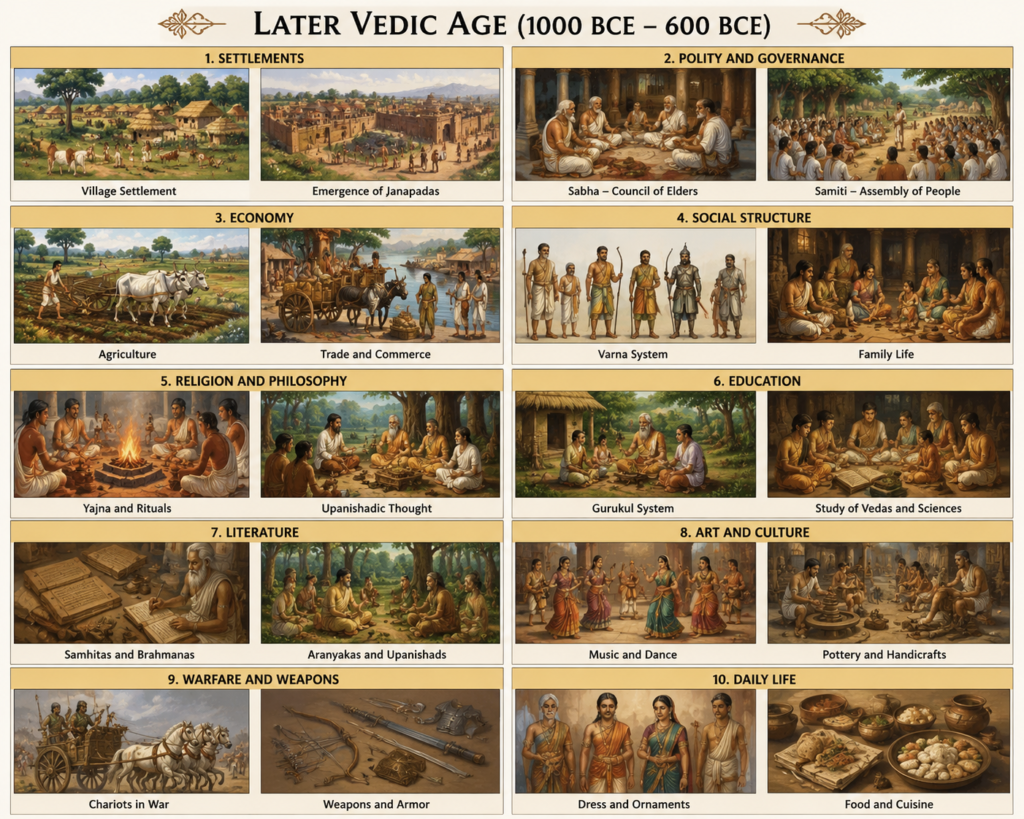
But Nishka was used as a convenient unit of value. In the Vedic period, collection of taxes and tributes was compulsory and was collected by Sanghari. Friends, like the Early Vedic period, it is important to understand religion here too because it is easier to understand the color of society through religion. So let’s move on to religion. Early Vedic Religion: The importance of the two most important gods of the Vedic period, Indra and Agni, ended in this era. In their place, Prajapati, i.e., the Creator, assumed the supreme position in this era. Some became prominent, such as Rudra, the God of Animals. God continued to be worshipped, but a substantial change was seen in the mode of worship. Prayers were still a caste of worship, but it was not the dominant mode of worship. A cornerstone of this cult was the Cult of Sacrifices, and this cult was based on various rituals and formulas. The importance of sacrifices had now increased in society. Sacrifices were of two types. There were public and domestic sacrifices. Public sacrifices involved the king and the entire community. At the individual level, there was a caste of sacrifice in the household as well, which was a domestic sacrifice. Sacrifice involved killing of animals on a large scale, especially cattle wealth. The person who sacrificed was called Yajaman, who performed the Yagya, and the guest was called Ghoghna. Some important sacrifices were Ashwamedha, Bajpayeeya and Rajasuya, the significance of which we have already seen.
The Brahmins had maintained a monopoly on priestly knowledge and expertise. They were given handsome rewards for fulfilling their sacrifices. Gold, cloth, and horses were given as dakshinas. Sometimes, they even demanded a portion of territory as dakshina, but there is no evidence of any such demand being granted. Conclusion: So, friends, we discussed the different aspects of the later Vedic period. In this period, people of the society started living a settled life instead of a semi-nomadic one. In the texts of the later Vedic period, we saw a strong reaction against the domination of the princely class. In the Upanishads, emphasis was laid on the knowledge of the soul, i.e., the self. Important changes were seen, such as the beginning of territorial kingdoms in the texts of this period. The Kshatriya rulers of the early Vedic times, the predominantly pastoral society, had now become an agricultural society. The tribal pastoral society had now converted into farmers. The tribes had a caste. The tribal presence of the king or the district continued to expand and reward the priests who supported them. The Shudras were still a small serving order, embezzling the common people, i.e. the Vaishyas. Overall, the most important development of the Vedic period was that it transformed from a tribal society to a society divided on the basis of varna.
