

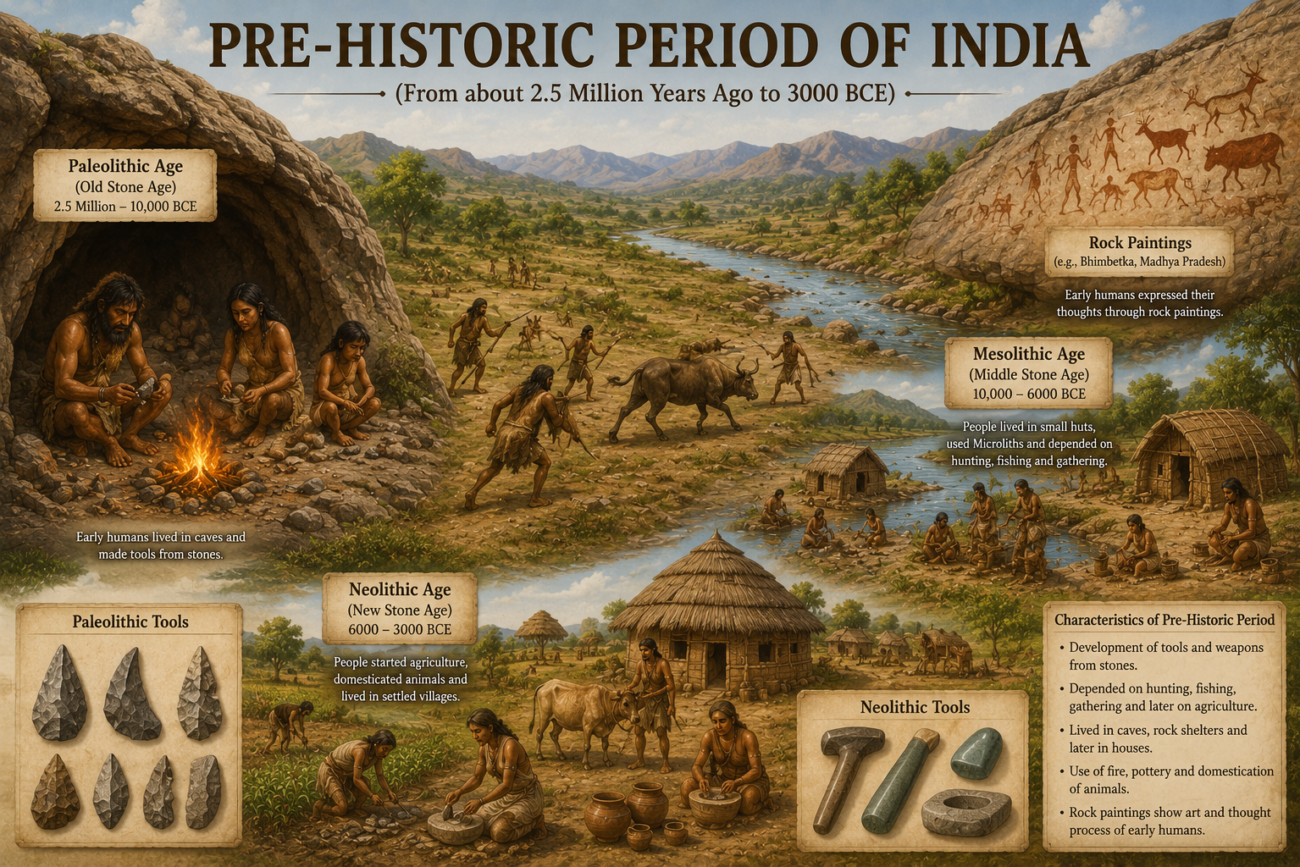
Pre-Historic Period of India: As the “Critical Voice” of the Indian Prehistoric Society points out the word “history” comes from the word historia which means inquiry or knowledge of the past. We all know that studying history means looking at more than stories; it also means looking at discoveries, collections and events that are tied to those stories. Therefore historians play an important role, in this field especially when it comes to sorting history records from different cultures.
Non Literary Sources and Literary Sources
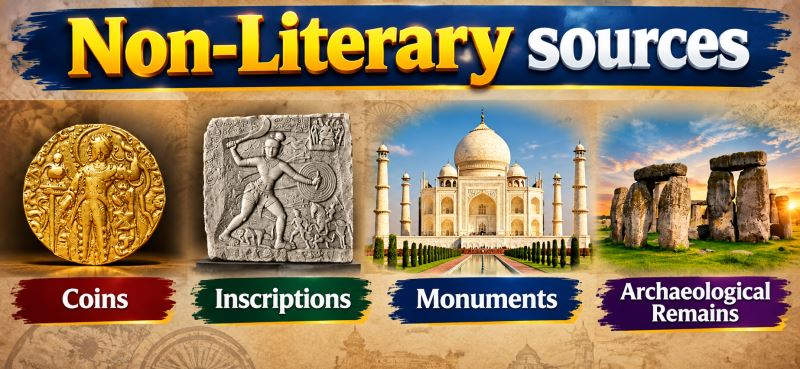
The first category is Non-literary sources, and The second is literary sources; coins and inscriptions are included under non-literary sources.
Pre-Historic Period of India
Prehistory is the time before writing. The knowledge we have, about Prehistory comes from pots, tools and metal objects found in places. In contrast history is the time when written records exist together with those clues.
Proto-History
Additionally the period between prehistory and history is called protohistory; this period means that some written notes exist,. Because the ancient writing systems have not been solved scholars have not been able to read the notes. Today we will talk about India’s period in detail and this period goes from about 200,000 BC to the 3500–2500 BC period. Researchers think that in this time people in India were part of the Negrito group and humans, in India survived by hunting and gathering. Over the prehistoric time humans slowly moved toward living in one place in different stages.
This foundational era of history is known as the prehistoric period. In India prehistory begins with the Stone Age. Archaeological evidence, from this period of human existence shows that stone tools are the most common artifacts that have been found. People likely. Used tools and weapons made of stone, wood and bone. However stone tools have survived better over time which is why this era is called the Lithic Age or Stone Age. Based on eras the types of stone tools and the lifestyles of prehistoric people the Stone Age is mainly divided into three periods. These periods are the Palaeolithic Age (Old Stone Age) the Mesolithic Age (Middle Stone Age) and the Neolithic Age (New Stone Age). I find this part of history. Let us explore this era in detail.
Palaeolithic Age (Old Stone Age) 30,00,000 BC To 10,000 BC
The Paleolithic Age lasted from about 300,000 BC to 10,000 BC. The word Paleolithic comes from two words: *palaios* meaning ‘old’ and *lithos* meaning ‘stone’; this shows how important stone tools were. This long Paleolithic period covers 99.9 % of all history. In India the credit for finding the evidence of the Paleolithic period goes to Robert Bruce Foote, a geologist with the Geological Survey of India.
In 1863 he found stone hand‑axes in the Pallavaram district of Tamil Nadu; because of this he is called the ‘Father of Prehistoric Archaeology.’The Paleolithic Age is split into three phases, based on the kinds of stone tools people used and changes in the climate. The first phase is the Lower Paleolithic Age from 300,000 BC to 100,000 BC.
This era happened at the time as the Ice Age and people mainly lived as hunter‑gatherers. Researchers say people used heavy stone tools like hand‑axes, choppers and cleavers; they also used limestone to make these tools. Bori, a town in Maharashtra is one of the oldest Lower Paleolithic sites. Also many sites have been found in the Kashmir Valley, the Didwana desert region of Rajasthan and the Thar Desert. Because stone tools were essential people looked for places where good stone was easy to find.
Ancient people made stone tools at these places called ‘factory sites; these also had caves and rock shelters. These places were also used for stays so they became known as ‘habitation‑cum‑factory sites.’ People chose caves because they protected them from rain, heat and strong winds. Natural caves and shelters are in the Vindhyas and the Deccan Plateau; these shelters are close to the Narmada Valley. The Bhimbetka caves and shelters in Madhya Pradesh are examples of these sites. Many different stone tools from this period were also found in the Belan Valley of Uttar Pradesh in the Vindhya region. Also evidence of the Lower Paleolithic Age was found at Nagarjunakonda in Andhra Pradesh. Other main sites, from this period are the Saurashtra region of Gujarat the Deccan Plateau and the Chota Nagpur Plateau.
Now let us discuss…
Middle Palaeolithic Age
The second phase the Middle Palaeolithic Age lasted from 100,000 BC to 40,000 BC. During this time humans started making pointed tools like flake points. These tools were used for hunting animals and preparing meat. Compared to the tools of the Lower Palaeolithic Age the tools of this era were smaller lighter and thinner. Remains from this period have been found at places along the Narmada River and south of the Tungabhadra River. Important sites linked to this era include the Luni Valley in Rajasthan, the Belan Valley in Uttar Pradesh and the Bhimbetka caves in Madhya Pradesh.
The third phase is the Upper Palaeolithic Age, which lasted from 40,000 BC to 10,000 BC. This period matched the part of the Ice Age, when the climate grew warmer and less humid. It was during this time that modern humans— the species Homo sapiens—first appeared. There were advances in technology. Stone tools became more refined. People created needles, burins, fishing tools, sided blades and boring tools. In India blade-based tools have been discovered in Andhra Pradesh, Karnataka, Maharashtra, Madhya Pradesh, southern Uttar Pradesh, Jharkhand and nearby areas. Blade tools have also been found in the layers of sand dunes in Gujarat. Bone tools, a trait of this period have been uncovered at the Kurnool and Muchatla Chintamani Gavi cave sites in Andhra Pradesh.
Far we have looked at the Palaeolithic Age. Evidence of climate change appears in the period between 12,000 BC and 10,000 BC. The Mesolithic Age brought rising temperatures and significant shifts in climate. As ice melted the environment changed. Flora and fauna shifted well. These changes led to improvements, in lifestyles and new tools.
The Mesolithic Age (Middle Stone Age) 10000 BC To 6000 BC
Let us take a look at the characteristics of the Mesolithic Age, which lasted from 10,000 BC to 6,000 BC. The word ‘Mesolithic’ comes from two words: meso and lithos. We already know that lithos means ‘stone’ and meso means ‘middle’;. This stage of history is also called the Middle Stone Age. Mesolithic culture is known for being more modern and more varied than the era. The first human settlement of the plains happened during this time. Microliths were the important tools of this age; these were small stone tools often made from fine-grained rocks like cryptocrystalline silica or chert. People used microliths to hunt animals and birds and also to make composite tools.
These composite tools were used for tasks such as gathering plants, harvesting and scraping. The first finds of microliths and other Mesolithic tools were found in the rock shelters of the Mirzapur district in Uttar Pradesh. Also the Bagor area in Rajasthan is one of the recorded Mesolithic sites. Located on the Kothari River excavations at Bagor found animal bones and shells along with microliths. Microliths have also been found in the valleys of the Tapti, Sabarmati, Narmada and Mahi rivers. As mentioned before the Mesolithic Age started with changes in the weather; warmer temperatures caused grasslands to grow in places leading to more animals like deer, antelope, goats, sheep and cattle.
People who had been hunter-gatherers started to learn about keeping animals their eating habits and when they breed. The earliest signs of keeping animals are seen at Adamgarh in Madhya Pradesh; the wild dog was the animal to be kept followed by sheep and goats as common animals kept. Mesolithic people also started to wear clothes made from animal skins. Also during the Mesolithic Age different grains like wheat, barley and rice began to grow in many parts of the subcontinent. Mesolithic people liked art and started rock painting; these paintings mostly showed things like animals, hunting and dancing. There are 150 Mesolithic rock art sites in India including important places like the Bhimbetka caves in Madhya Pradesh, Karwara, Sambalpur and Sundargarh in Odisha and Erat Guha in Kerala. These paintings also show how religious beliefs changed; unlike people from the Paleolithic era those in this time believed in life after death so they buried human and animal remains with food and other items.
Langhnaj in Gujarat and Baranpur in West Bengal are also Mesolithic sites. Many microliths have been found there along with bones and the bones of wild animals like rhinoceroses and blackbucks. Friends, the time that came after the Mesolithic era lasting from 6000 BC to 1000 BC is called the part of the Stone Age: the Neolithic Age. Let us take a look, at the characteristics of the period.
The Neolithic Age (New Stone Age) 6000 BC To 1000 BC
The Neolithic Age spanned from 6000 BC to 1000 BC. The word “Neolithic” comes from Neo” meaning “new”; therefore the Neolithic Age means “New Stone Age.” The famous archaeologist Gordon Childe in his book Man Makes Himself said that the Neolithic Age changed life calling it the Neolithic Revolution. In the Paleolithic Age people were hunter‑gatherers who depended entirely on nature. In the Mesolithic Age people began to tame animals. The Neolithic Age is the time when people shifted from gathering food to producing food. This time is important because it marks the start of farming. Sites such as Koldihwa and Mahagara near Allahabad, UP show the evidence that people grew rice not only in India but all over the world. In contrast to the Old Stone Age people in the Neolithic Age used stone tools and axes often called celts, which were far more refined than the rough flaked stone tools of earlier times. People also used bone tools, such as needles, scrapers, borers and arrowheads.
These new polished tools made farming, hunting and other tasks easier. Bone weapons have been found at the Chirand site in Bihar. In farming the Neolithic Age people grew ragi, cotton, rice, wheat, barley and horse gram. They kept cattle, sheep and goats. At the Burzahom site in Kashmir a dog’s remains were found beside a burial proving that dogs were domesticated. Other places where Neolithic Age people lived with both farming and herding include Hallur and Maski in Karnataka. The Brahmagiri site shows that the Neolithic Age domesticated plants and animals and produced amounts of food grains and animal feed. To keep grains and cooked food people began making clay vessels or pottery during the Neolithic Age. Pottery of the Neolithic Age falls into classes such, as Grey Ware, Black Burnished Ware and Mat‑Impressed Ware.
At first pottery was handmade. Later the Neolithic Age people invented the potter’s wheel, which changed how pottery was made. Neolithic Age people also learned to weave cotton and wool. The earliest cotton appears at the Mehrgarh site in present‑day Pakistan. Neolithic Age people built circular houses of mud creating the first settled societies and the earliest Indian villages. Pit dwellings have been found in the Kashmir Valley showing that Neolithic Age people sometimes lived in pits.. Neolithic Age people did not travel far from hills and river valleys because they still relied heavily on stone tools and weapons. They also depended on nature for the supplies needed for farming, pottery and animal domestication. Finally Neolithic Age people began to use metals, copper and low‑grade bronze. This new phase, defined by metal use became known as the Chalcolithic or Copper‑Stone Age.
The Chalcolithic or Copper‑Stone Age (2000 BC To 500 BC )
The Chalcolithic Age from 2000 BC to 500 BC is a culture mostly seen during the -Harappan phase. This time period is known for the rise of animal husbandry and small rural settlements. In places the Chalcolithic Age continued into the post-Harappan phase as well. The pre-Harappan phase was a bridge between the Neolithic Age and the Harappan Age. It helps us understand how the Harappan civilization slowly developed over time. During this time people began using copper to make tools like axes, fishhooks, pins, knives and rods. Houses were built using stone and mud bricks. Burnt bricks were not yet common.
The Gilund site in Rajasthan is an exception, where some baked bricks have been found. Society during the Chalcolithic Age was not urban. It was mostly rural with people living in villages. There were differences in classes. Village chiefs lived in houses while ordinary people lived in small round huts. Burial practices varied a lot. Some people were buried in graves, others in box-shaped graves and some in rock-cut tombs. The dead were usually buried under the floors of houses facing north-south. They were buried with pottery and copper objects.
In Western Maharashtra many graves contained infant remains showing that infant mortality was high during this time. Art and crafts were growing. There were copper-smiths and stone workers. People were also good at spinning, weaving and making cloth.. They did not know how to write. One key feature of the period is its polychrome painted pottery. Black-and-red ware was especially common. Ochre-coloured pottery was also very popular. Evidence of this pottery has been found in Rajasthan, Punjab, Haryana and Western Uttar Pradesh. People liked ornaments too.
Women wore jewelry made from shell and bone. They also made bead necklaces using -precious stones like steatite and quartz crystal. The Chalcolithic era had cultures, named after the places where they were found. One is the Ahar or Banas culture in Rajasthan. It is named after the Banas Valley, where most of its sites are located. This is one of the Chalcolithic cultures in India. Major sites have been found in Udaipur, Bhilwara and Rajsamand. Stone blades have been found in these places. Another important culture is the Kayatha culture. It is located in Ujjain, Madhya Pradesh along the Kali Sindh River, a tributary of the Chambal. The Malwa culture is the important Chalcolithic culture, in Central India.
It covers the Malwa area near the Narmada River; from there food grains like wheat, barley, oilseeds, sorghum, rice and legumes as well as terracotta bull figurines have been found. The Jorwe culture in Western Maharashtra is along the Pravara River; the Daimabad area in Ahmednagar is a site of the Jorwe culture, where items like bronze elephants, rhinoceroses and two-wheeled chariots have been discovered. Other important sites are Chirand in Bihar, Navdatoli in Madhya Pradesh, Rangpur in Gujarat and Inamgaon and Nashik in Maharashtra. So overall Chalcolithic sites in India show regions. Far we have studied the different stages of the Stone Age; the same thing happened in all those times, which was the use of stone to make tools or weapons.. Around 1000 BC, another period started in India where stones were used—more than just tools—to build burials and memorials; this time is called the Megalithic period. Let us look closely at this period. The Megalithic period lasted from 1000 to 500 BC.
The word “Megalith” means ” stone ” and the culture involved making burials or memorials with large stones. These Megalithic structures can be divided into two kinds: lithic and monolithic. Lithic structures were made with many stones while monolithic structures used only one stone. Although these structures have been found in places across India the Megalithic culture is especially known in Southern India, where many different kinds of Megalithic graves and memorials have been found. These include the menhir burials in the Maski and Gulbarga areas of Karnataka, the hood-stone memorials in Andhra Pradesh and Kerala and the umbrella-stone graves in Kerala. Also dolmen-shaped tombs have been found in Brahmagiri (Karnataka) and Chingleput (Tamil Nadu) well as rock-cut cave memorials in Cochin.
In Northern India such megaliths have been found in Burzahom and Gufkral (Kashmir) well as in the Banda, Allahabad, Mirzapur and Varanasi areas of Uttar Pradesh. Also most of the monuments in Maharashtra have been found in the Vidarbha region. Researchers found features in these burials: usually red-and-black pottery was buried with the dead. Iron tools and weapons well as stone and gold jewelry were also found. In some burials the bodies had horses and horse equipment or animals like buffaloes, sheep and goats. For example at the Brahmagiri site in Karnataka a body was found with 33 gold beads, two stone beads and four copper bangles; in places only a few pots were found with the bodies. The things found with the bodies were probably related to the people who were buried. These finds show that there was a divide among the people who had these burials some were rich and some were poor and there were differences between leaders and regular people. A special thing about this time was the use of red-and-black pottery. It is interesting to note that black-and-red pottery was found with burials in both the north and the south. While the pottery varied by region the way it was made and decorated was similar. Also finding iron objects in these burials shows that this culture belongs to the Iron Age. From findings the use of iron in India started between 1000 BC and 500 BC; during this time iron tools and weapons were common and writing also began. So the Megalithic period is the time of the Iron Age that shows the change from prehistory to history. In the end Indias prehistoric time included the Stone Age, the Copper Age and the Iron Age; prehistoric India had the Ice Age and the start of Homo sapiens. This talk shows the steps of human development. It was during the time of the prehistoric era that the base, for the next time specifically the Harappan Civilization was built.
People also ask
What is called the pre-historic period?
Who is the father of prehistory in India?
What are the three periods of Indian history?
What are the four ages of prehistory?
What are the three main periods of prehistory?
