

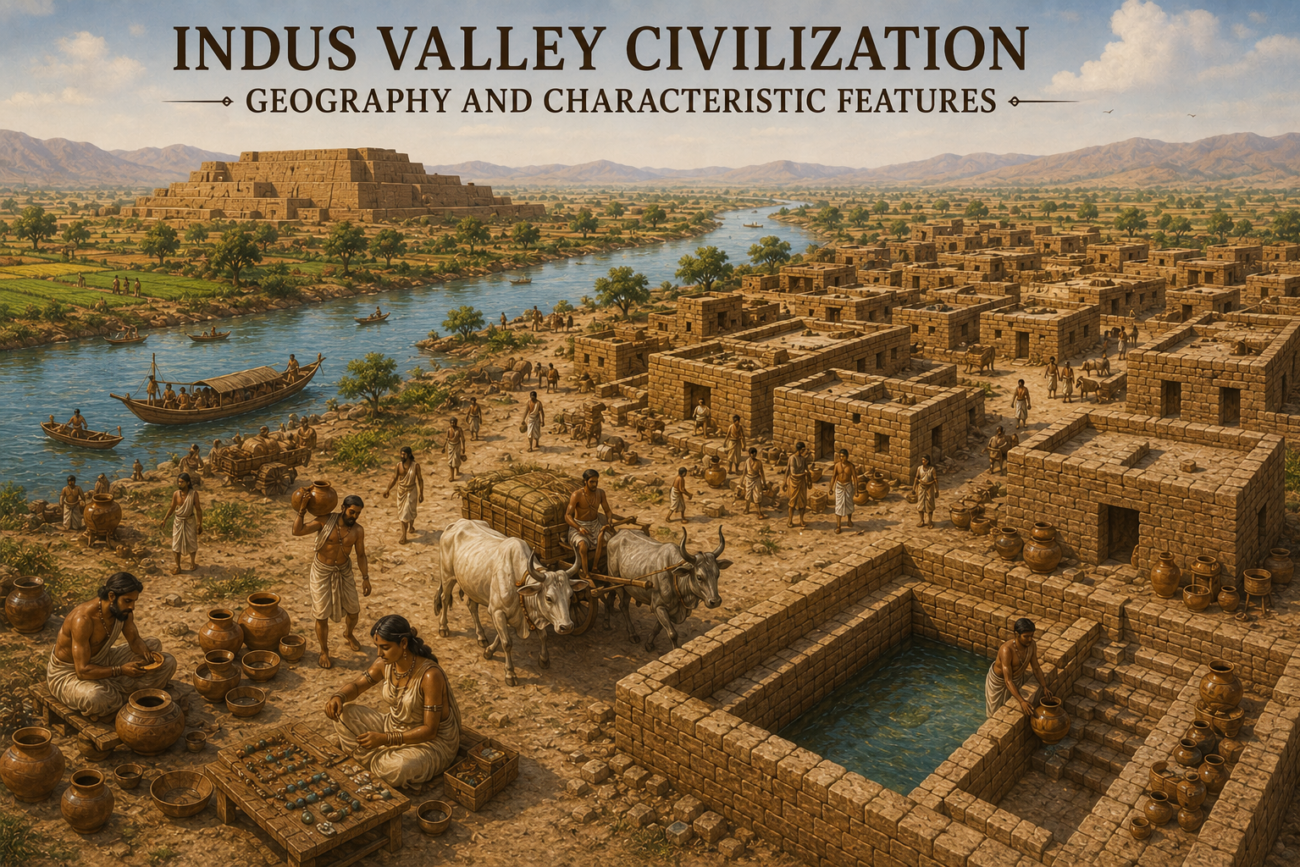
Friends, today we are going to talk about the Indus Valley Civilization, which is the oldest in Indian history and one of the oldest urban civilizations in the world. The Indus Valley Civilization, or IBC, came into existence as an urban civilization around 4500 years ago, in 2600 BC, and when barbarism was far away across the world, the Indus Valley Civilization was setting the standards. The knowledge gained about the Indus Valley Civilization is an aspect of our history that also helped in challenging the cultural practices of a system like colonialism, which has nothing to be proud of. This gave birth to the idea of the White Flesh Burden, on the basis of which the British tried to justify their 200-year-long rule. Even the famous English philosopher, Jesse Mill, who was a great supporter of democracy and freedom, justified British colonialism, promoting tolerant imperialism, and claimed that the British came to India for our welfare and to stabilize us.
But this pride of the West began to crumble when Alexander Cunningham, under the Archaeological Survey of India (ASI), conducted several major archaeological excavations in the 19th century, uncovering brilliant ancient architecture in the world, such as the Sarnath, Sanchi Stupa, and the Mahabodhi Temple. However, the most remarkable discovery was made by Indian archaeologist Dayaram Sunny in 1921 when he excavated Harappa. This discovery astonished historians worldwide, as it was a unique example of well-planned organization in its time, inspiring us even today. This discovery, while exposing the British, revealed that while Europe was grappling with barbarism, an urban civilization in India was scaling new heights every day. This story is of the Indus Valley Civilization, which gave Indians a chance to be proud of their history and showed the world that the West should not have a monopoly on civilization. Power has come, so first, let us understand some of the major features of the Indus Valley Civilization, which will help us understand other aspects of this place. Basic Features Friends, Indus Valley Civilization title for the first time. John Marshall did it, but it is also called the Harappan Civilization. The IVC was contemporary to three other major civilizations of Asia: Mesopotamia, Egypt, and China. There is also evidence of trade relations of the Indus Valley with Mesopotamia. The cities of the Indus Valley were urban towns based on agriculture, but the economy here was also based on mercantilism, from where massive exports took place through both sea and land routes.
In this context, we will now briefly understand the history of the Indus Valley excavations. Excavations in British India and Independent India: Friends, the earliest record of Harappan ruins is found in the East India Company’s Journalism in Baluchistan, Afghanistan, and the Punjab, which they wrote in 1842. Another thing to note is that British Imperialism was a systematic problem, not an individual one. This is because many Britishers, such as Alexander Cunningham, gave importance to India’s ancient color and civilization history and promoted research on it. This is why, in 1853, Alexander Cunningham also came to know about the IBC when he visited Harappa, but he probably did not understand its significance. Later, in 1921, Daya Ram Sunny excavated Harappa, and then in 1922, Rod Banerjee excavated Mohenjo-daro. Since then, excavations have been continuously taking place at the Indus Valley, including many prominent ecologists like G. Majumdar and Amalananda Ghosh. RS Bisht, GP Joshi, R Rao and Vasant Shinde were the world leaders in IBC and discovered sites like Suddh, Gandor, Kalibangan, Lothal and till date more than 2000 Indus sites have been discovered. Friends, if we talk about the excavations of independent India, the most major discovery was by RS Bisht in 1990 when he found stone inscriptions and IndusInd boards in Dhola Veer. IndusInd boards are the longest inscription of Indus script on wooden plates.
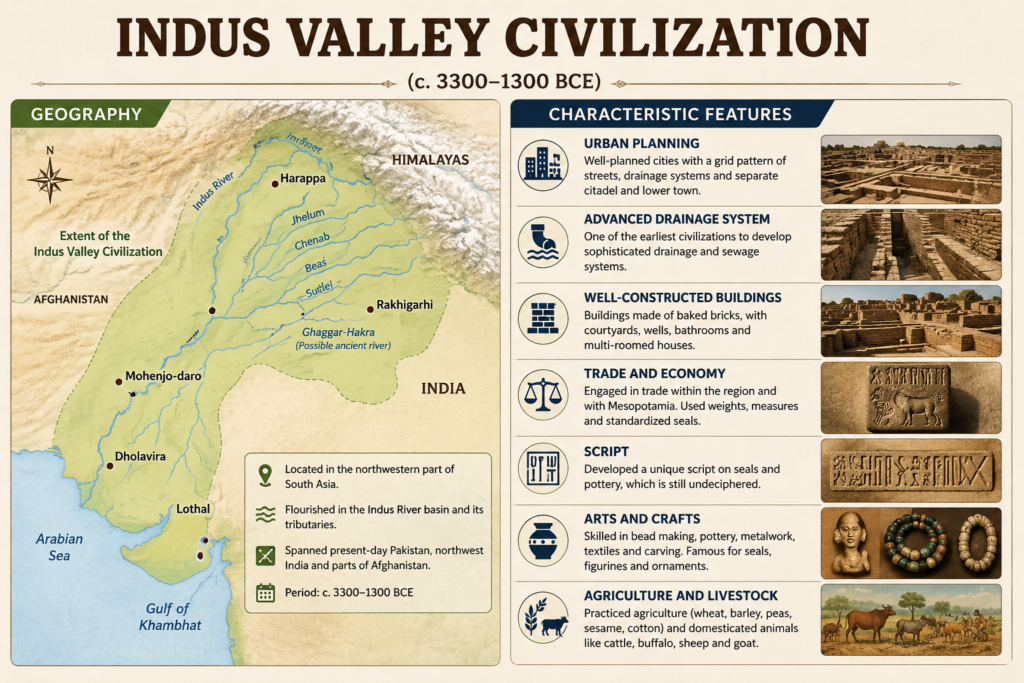
and the stone inscription is the first such inscription which is in stone. The inscriptions found before this were inscribed in terracotta wood etched in it. Apart from this, the second major discovery was the Rakhigarhi site of India, which was first excavated by Amarendranath in 1997. In 2014, the excavations of Vasant Shinde made it the largest site of the Harappan civilization. It is spread over approximately 350 hectares and surpassed Mohenjo-daro of Pakistan, spread over 300 hectares. Well, now we talk about how historians classify the history of IVC. Friends, historians generally divide IVC into phases. The first is Early Harappa, which is the phase before 3300 BC. In this period, nomadic people started making settlements and agriculture started. The second is Early Harappa, which was from approximately 3300 BC to 200600 AD. In this period, large fortifications were made in Harappa. Villages emerged which later converted into urban towns. The third and most important phase is Mature Harappan (2017). The last phase is Late Harappan which is found in 1900 AD to 1300 AD. Here the decline of IVC is visible, after which this civilization gradually became history. Let us now take you to the geography of Indus Valley and know from where to where it was spread.
The Harappan sites of the Indus Valley Civilization were located around Punjab, Haryana, Singh, Balochistan, Gujarat, Rajasthan and Western Uttar Pradesh and around the Indus and Indus tributaries like Ravi, and that is why John Marshall called it the Indus Valley Civilization. According to one theory, the IVC originated here, but later due to the decline and environmental changes in the Indus Valley, the people from here probably moved to the Ganga Valley, where later the post-Harappan settlements, Mahajanapadas and Kingdoms like Magadha emerged. Till now, the most important Harappan sites are Alamgirpur, Easternmost, Sood Ka Gand and Westernmost. Of the more than 2000 sites found in the Indus Valley, most of them are in India and Pakistan, which were probably trading colonies of the Harappans. Port cities include Lothal, Kuntasi in Gujarat, Aladdin, Balakot and Sood Ka Gand in Pakistan, from where evidence of major trades comes from in Mesopotamia. Harappan cells have been found. Next, we discuss the major excavations of the Harappan civilization, which are the primary historical sources for integrating the history and society of this place. Its town planning, whose brilliance can be compared to modern plant cities like Chandigarh and New Raipur. Except for a few sites, a 45-seater fort or fort is found to the west of most sites.
The construction probably served the working class and small brick houses in the east, which may have been for the commonwealth, showing social stratification and indicating that divisions based on status and power existed since the Harappan period. These divisions were not like the caste system. The citadel at Dhola Vir was built of stone, and there was also a middle town here, likely for the middle class, which has not yet been discovered. The citadel of Lothal was not 45 feet high but was built on a slightly higher elevation. We are currently struggling, whereas 4100 years ago, Harappa demonstrated an inspiring example by using minimal technology. Almost all the states in the Indus Valley Civilization were connected to each other at right angles, forming the basis of the city layout. A third interesting feature is the remarkable underground drainage system. In Mohenjo-daro, drains were found in all the streets, and almost every house had arrangements for wastewater management. The walls of these houses had vertical pipes connected to the drains. These pipes also included small settling chambers and traps that removed sediments from the drains. These could become clogged or trapped but were easily cleared. The emphasis on sanitation seen in the current Swachh Bharat Mission in modern India, the presence of wastewater management as a key feature and an advanced system in these ancient cities, is also due to their scale. In India, before or shortly after this period, there was also significant work in tax collection and management. Now, let’s discuss the architecture here. The most important architectural achievement of the Indus Valley Civilization is the Great Bath of Mohenjo Daro. It is a structure measuring 6 by 12 meters made of large bricks, and its purpose was likely religious, with ritual baking possibly involved. The floor and outer walls of the Great Bath were coated with bitumen, making it waterproof. Stone is not visible in this structure. In addition, there is also a large water tank at Dhola Veer. The next structure is the granaries. The Great Granary of Mohenjo Daro is the largest, and it might have been used to store the oil collected from taxes. Six similar granaries have been found in Harappa as well. There were also two room barracks here, where the workers might have lived.
Let’s look further at the story of eight more crafts from Harappa. Friends, IBC is also famous for its brilliant and well-developed artifacts and sculptures. It tells us about possible god worship, laser toys, materials, etc. in Harappan society. Although craft-making was a common practice here, most craft production took place in industrial towns like Chandwador, Nageshwar, and Balakot. Many of these crafts can still be seen in the Indian and British Museums. Stone Sculptures: The most famous sculpture is the upper part of a male body, or torso, made in red sandstone. The torso’s nicks, shoulders, heads, and arms have socket holes and are quite detailed. The sculpture of a bearded mother, made of stout or soup rock, is the most discussed subject. It was probably a priest, as its repeated representations are found elsewhere. This sculpture is wrapped in a patterned shawl, whose edges are elongated and half-closed. Looking at it, it seems as if she is in meditation. Her nose, mouth or mouth shows that bronze casting was in embroidery practice here. Friends, bronze casting was also popular in IBC, which is seen as a continuous tradition in India. Its example is the famous Nataraja colour, the chola of which was made by her in the 11th century.
The flame wax technique is used for bronze casting at both sites. The most famous bronzes at the Indus Valley are the Dancing Girl, Buffalo Goat animal figure, and the ball sculptures at Kalibangan and Mohenjo-daro. Terracotta art: Terracotta, i.e., reddish-brown figures made from natural clay, were also common here, but the detailing of terracotta figures is not as brilliant as that of bronze and stone statues. The most famous of these are the Mother Goddesses, Bearded Mills, Masks of Hunting, Deity Cards, and Cels. The most prominent terracotta figure is the Mother Goddess, a crude, standing female figure adorned with a nickel-plated lion, cloth, and girlish decorations. Its most distinctive feature is the fan-shaped headdress with cup-like projections on both sides. The remaining facial features are crude and less realistic. Cels are also available in copper, faience, gold, ivory, and silver. Cels were used in general trade, perhaps as proof of authenticity today. The most popular of these is the Pashupati Cel of Mohenjo-daro. Pottery: The next important craft is the pots found here, which were largely wheel-made, not hand-made. [Praise be to say] straight and angular shapes. Apart from these, spindle wheels used for cloth-making have been found in many houses, which are indications of the common practice of cloth-making. The Harappans also knew the craft of pot-making, the use of which was seen even in modern India, where 16 annas were used for ₹1. So this was that aspect of the history of the Indus Valley Civilization, in which we discussed its geography, town planning, architecture, major constructions and crafts-making. These excavations are the primary evidence of Harappan history, through which we can understand other aspects of their history and society, such as politics, society, economy, religion, color and civilization.
